Georgia Did Not Make It Onto Your Radar By Accident. The Complete Women’s Guide to Tbilisi and the Caucasus
Part of the Real Shee Power Travel Series: 🔗 She Packed One Bag And Got Her Whole Life Back: International Solo Travel for Women 🔗 That Horse Riding Reel From Kazakhstan Is Real 🔗 She Rode Into the Horizon: The Complete Guide to Horse Riding Travel for Women 🔗 India’s Safest Hidden Destinations for Women Travellers 🔗 Kerala for Women Travellers: The Complete Guide
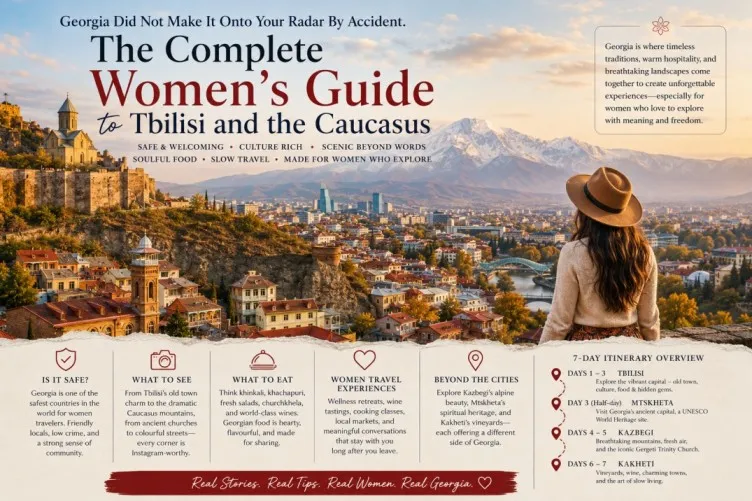
There is a city at the crossroads of Europe and Asia where sulphur baths have been heated by natural geothermal springs for fifteen centuries, where wine was being made in clay vessels before most of Europe had a written language, where medieval fortresses sit above cobblestone lanes and rooftop bars, where the hospitality is so genuine that strangers still invite you to their table without ceremony.
That city is Tbilisi. And the country surrounding it, from the dramatic Caucasus peak of Kazbegi to the wine valleys of Kakheti to the Black Sea coast at Batumi, is one of the most complete, genuinely surprising travel experiences available to Indian women right now.
Georgia welcomed 6.5 million international visitors in 2024. Indian arrivals have been growing rapidly, and for entirely good reason. The combination of striking landscape, layered history, outstanding food, accessible visa process, direct flights from Delhi and Mumbai, and price points significantly below comparable European destinations makes it an unusually compelling case.
This guide covers everything, not the sanitised highlights reel, but the specific, practical, honest information that makes the difference between a trip that goes well and a trip you talk about for years.
Table of Contents
Why Georgia Works So Well for Indian Women Travellers
The Safety Picture
Georgia consistently ranks among the safest countries in Europe and Central Asia for tourists. Crime rates are low, Tbilisi’s Old Town and major tourist areas have visible policing and well-maintained public infrastructure, and the general attitude toward solo women travellers is welcoming rather than predatory. Multiple women travel communities and platforms consistently rate Georgia highly for solo female travel, and RealShePower readers who have visited report feeling remarkably comfortable navigating the city alone at night.
This does not mean switching off awareness. It means Georgia starts at a baseline that many popular destinations do not offer, and that baseline makes the experience qualitatively different, particularly for Indian women who have navigated the additional cognitive load of solo travel in more challenging environments.
The Cultural Fit
Georgia sits genuinely at the crossroads of East and West. The architecture, food culture, hospitality traditions, and social warmth have a quality that Indian women consistently find familiar rather than alienating. The tradition of the Georgian supra, a feast at which the tamada (toastmaster) leads elaborate, heartfelt toasts to guests, family, peace, and love, will feel immediately recognisable to anyone who grew up in a culture that understands hospitality as a form of love rather than a transactional service.
Georgians are extraordinarily proud of their culture, their food, their wine, their history, and their language (one of the oldest and most distinctive in the world, with its own alphabet). Arriving with genuine curiosity and respect for all of this is the surest way to unlock the best of what Georgia offers.
The Value
Georgia is significantly more affordable than Western Europe while offering what many travellers describe as a European-adjacent quality of experience. Good boutique hotels in Tbilisi Old Town run from roughly 3,000 to 7,000 rupees per night. Meals at genuinely excellent Georgian restaurants cost a fraction of equivalent quality in Paris or Rome. Wine, which is extraordinary here, is priced at a level that makes tasting widely rather than selectively entirely reasonable.
For Indian women who want an international trip that feels genuinely special without the eye-watering cost structure of Western Europe, Georgia offers a compelling middle path.
🧞 Real shee power Genie Says
“Georgia is what Europe looked like before it became expensive and self-conscious about being visited. The hospitality is real. The food is extraordinary. The wine will ruin you for ordinary wine forever. Go before everyone else figures this out.”
Part Two: The Visa Reality for Indian Travellers in 2026
Let us be completely clear here, because the rules are specific and worth understanding precisely before you book anything.
The Standard Route: e-Visa
Most Indian passport holders need a Georgia e-Visa to enter. The good news is that this is one of the simplest visa processes available for an international destination.
The standard Georgia e-Visa costs USD 20, with 5-day processing, or USD 50 for urgent 3-day processing. The application is completed entirely online through the official Georgian e-Visa portal.
What you need for the application:
- Valid Indian passport with at least 6 months validity from your entry date and a minimum of 2 blank pages
- Recent passport-sized photograph against a white background
- Scanned copy of your passport biodata page
- Confirmed return or onward flight booking
- Proof of accommodation (hotel booking or host invitation)
- Bank statements showing sufficient funds, roughly equivalent to USD 50 to 100 per day of your stay
Travel and medical insurance covering your stay, with a minimum coverage of 30,000 GEL (approximately USD 11,000) for emergencies and repatriation. As of January 1, 2026, health and accident insurance is mandatory for all visitors entering Georgia.
Processing time: Standard 5 to 7 working days. Apply at least 2 weeks before your travel date to allow for any follow-up.
Duration: The e-Visa allows a stay of up to 30 days.
The Shortcut: If You Hold a Valid Foreign Visa
Indian passport holders who hold a valid multiple-entry visa or residence permit from the US, UK, Schengen Area countries, Canada, Australia, Japan, New Zealand, South Korea, the GCC countries, or Ireland can enter Georgia visa-free for up to 365 days.
This is one of the most generous reciprocal entry policies in the world. If you hold any of these visas, you simply present your Indian passport and the valid foreign visa at the Georgian border.
Always verify current visa rules directly on the official Georgian e-Visa portal (evisa.gov.ge) before booking flights. Visa policies can change, and this guide reflects conditions as of July 2026.
Direct Flights from India
Direct flights operate from Delhi and Mumbai to Tbilisi.
Airlines including Air Arabia, flydubai, and IndiGo (via Dubai or Sharjah) connect Indian cities to Tbilisi International Airport with reasonable journey times and competitive pricing. Flying time from Delhi via one connection is typically around 6 to 8 hours total. Check current routing options on Skyscanner or Google Flights when planning.
Part Three: Tbilisi — The City Itself
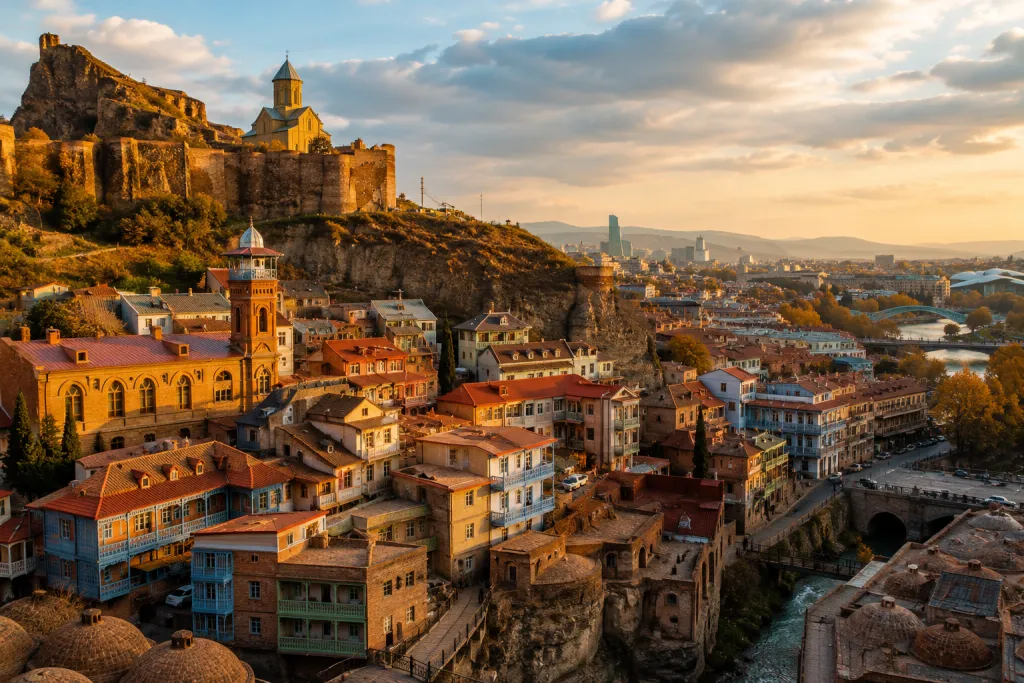
Tbilisi is a city that rewards wandering more than planning. Its geography is vertical: the Mtkvari river runs through the valley bottom, the Old Town (Dzveli Tbilisi) climbs the hillsides above it, and Narikala Fortress crowns the ridge. Most of the experiences worth having are found on foot, in the gaps between the sights rather than at them.
The Old Town: Where to Spend Most of Your Time
The Abanotubani district, the sulphur bath quarter, is where Tbilisi’s origin story lives. Its domed sulfur bathhouses mark the historical origin of the city. The baths are fed by natural hot springs discovered, according to legend, when a Georgian king’s hunting falcon fell into the steaming water in the 5th century. Several bathhouses offer private rooms for solo travellers, typically priced between 20 and 40 GEL (roughly 600 to 1,200 rupees) per hour. For a solo woman, the private room is the recommended choice: your own steam, your own soak, your own silence.
The carved wooden balconies of the Old Town are distinctive to Tbilisi and unlike anything in the rest of the Caucasus. These projecting balconies, often painted in faded pastels and draped with laundry or potted plants, give the city its most characteristic visual quality: layered, organic, slightly precarious, and entirely beautiful. Walk the lanes of Shardeni Street, Leselidze Street, and the area around Anchiskhati Basilica (the oldest church in Tbilisi, dating to the 6th century) slowly. There is always something in a doorway or above a roofline that makes you stop.
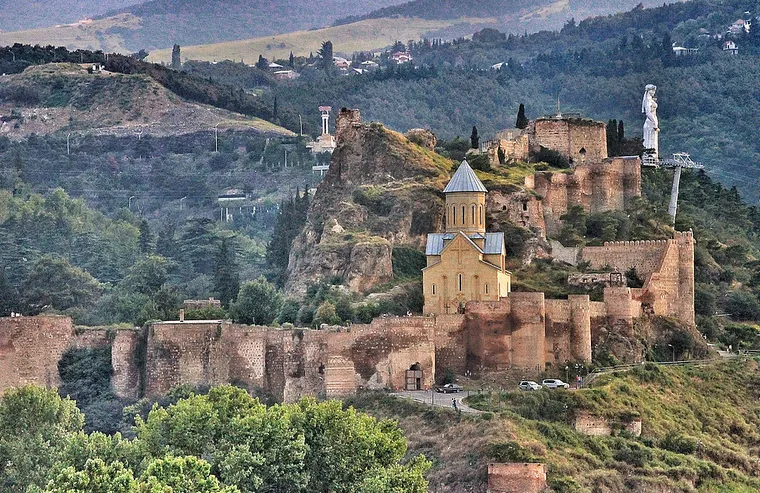
Narikala Fortress at the top of the ridge is reachable by cable car from Rike Park (one of the most pleasant cable car rides in any city, with the Old Town spreading below you as you ascend) or by a steep walk through the fortress walls. The view from the top encompasses the full arc of the city and the river valley, and at dusk, with the light turning the stone gold and the city beginning to light up below, it is one of the finest urban views available anywhere in the Caucasus.
The Sulphur Baths: A Practical Guide for Women
The traditional public baths in Abanotubani range from the ornate Chreli-Abano (known for its mosaic-covered facade and reliably hot water) to simpler neighbourhood bathhouses used primarily by locals. For solo women, booking a private room in advance is strongly recommended, especially in peak season (June to September).
What to expect: you enter a tiled room with a hot sulphur pool, a cold plunge, and in the better establishments, an optional kese (exfoliation scrub) performed by an attendant. The sulphur smell is strong and distinctive. The water is genuinely very hot. The experience is deeply relaxing, particularly after a day of walking the city’s hills. Budget roughly 60 to 100 GEL for a private room with a kese, and tip the attendant separately.
Tbilisi’s Food Scene
Georgian cuisine deserves its own section and will likely become one of your primary reasons to return. A few essential introductions:
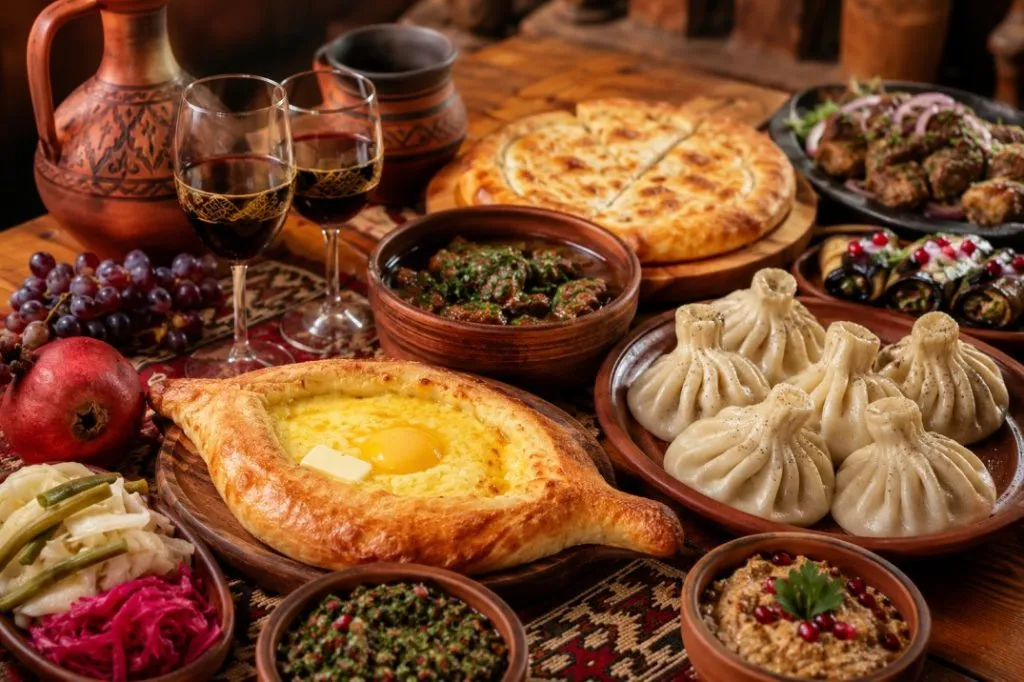
Khinkali: Soup dumplings, large and pleated and filled with spiced meat or mushrooms or cheese. The technique for eating them is important: lift by the knot (the knot is not eaten, it is how you hold the dumpling without burning yourself), bite a small hole, sip the broth inside before eating the rest. Ordered by number, a standard serving is 5 to 8 dumplings per person.
Khachapuri: Georgia’s most famous dish, bread filled with cheese and egg in regional variations. The Adjarian version (open-boat bread with a molten egg cracked in the centre and a knob of butter stirred in at the table) is the one most photographed and most worth ordering first.
Lobiani: Bread filled with spiced kidney beans. Simpler than khachapuri, deeply satisfying, and widely available as street food.
Churchkhela: A street snack of walnuts threaded on a string and dipped repeatedly in thickened grape juice until they form a candle-shaped coating. Available everywhere in autumn when the grape harvest is fresh. An extraordinary combination of textures.
Georgian wine: Georgia has been making wine for approximately 8,000 years, the longest continuous winemaking tradition in the world. The amber wine style (white grapes fermented on their skins in qvevri clay vessels, producing a tannic, deeply coloured, complex wine unlike anything from France or Italy) is specifically Georgian and worth seeking out even if you do not typically drink white wine. Try it at any wine bar in the Old Town, several of which offer tasting flights.
Where to eat in Tbilisi: Shavi Lomi and Barbarestan are the two consistently excellent mid-to-upper range restaurants worth a reservation. For more casual, high-quality Georgian food at local prices, the covered Dezertirebi Market (Dry Bridge Market) area and the small family restaurants along Leselidze Street offer some of the most honest cooking in the city.
🧞 Real Shee POwer Genie Says
“Order khinkali. Drink amber wine. Sit at the table until the conversation you didn’t know you needed happens. This is what Georgian hospitality is built for. Let it work.”
Part Four: Beyond Tbilisi — The Regions That Make Georgia Extraordinary
Kazbegi (Stepantsminda) — For the Mountains
Three hours from Tbilisi by shared minivan (marshrutka) or private transfer along the Georgian Military Highway, Kazbegi sits in the Greater Caucasus range at 1,740 metres above sea level. The landscape is dramatic in the specific way that very few places in the world achieve: the valley is deep and narrow, the mountains rise steeply on every side, and above the town on a prominent hilltop sits the Gergeti Trinity Church, a 14th-century stone church that with Mount Kazbek (5,047 metres) rising behind it produces one of the most genuinely iconic landscape photographs in all of travel.
For Indian travelers, especially honeymoon couples and photography-focused tourists, Kazbegi represents the cinematic side of Georgia.
The walk up to Gergeti Trinity Church takes roughly 1.5 to 2 hours each way from the town of Stepantsminda and is moderately strenuous but achievable by most reasonably fit travellers in good weather. The trail is clearly marked and well-used. Alternatively, a 4×4 vehicle can be hired in town for the ascent, which takes 20 minutes but delivers less satisfaction. For solo women travellers, the walk up is strongly recommended: the path is well-populated with other hikers, the reward at the top is proportional to the effort, and the views from the ridge as you ascend are extraordinary.
Staying in Kazbegi: The Rooms Hotel Kazbegi is the most photographed accommodation in the country, a design hotel built into the mountainside with floor-to-ceiling mountain views that justify the price on clear mornings. For more accessible budgets, the town has multiple excellent guesthouses, many family-run, offering rooms from 600 to 2,000 rupees per night with home-cooked Georgian breakfasts.
Practical note: Mobile signal is limited in parts of the valley. Download offline maps for this region before leaving Tbilisi.
Kakheti — For the Wine
One to two hours east of Tbilisi, the Alazani Valley is Georgia’s primary wine region, a wide, fertile plain between two mountain ranges where grapes have been grown and wine made in clay qvevri for millennia.
The towns of Sighnaghi, Telavi, and the surrounding villages are worth at least two days. Sighnaghi specifically, a small walled town on a hill overlooking the valley with views to the snow-capped Caucasus on a clear day, is one of the most photogenic settlements in Georgia and small enough to walk entirely in an afternoon. The Bodbe Monastery, a short drive from Sighnaghi, is the resting place of St. Nino, the woman who brought Christianity to Georgia in the 4th century, and the site has a particular spiritual quality, quiet and lived-in, that many women travellers describe as unexpectedly moving.
Winery visits in Kakheti range from large commercial estates with formal tasting rooms to small family operations where you sit at a table under a grapevine canopy and the grandmother brings out bread and cheese alongside whatever they bottled last autumn. Both are worth experiencing. For booking, Twins Wine House near Napareuli and Schuchmann Winery near Telavi have strong reputations for quality and for genuine hospitality toward international visitors.
Batumi — For the Black Sea
On Georgia’s western coast, Batumi is a beach city that defies simple categorisation. It has a UNESCO-listed botanical garden, a geometric Art Nouveau European boulevard, high-rise towers built in the 2010s construction boom, a casino strip, and directly beside all of this, a genuinely beautiful Black Sea coastline where you can swim in warm, clear water from May to October.
For Indian women, Batumi is a useful addition to a longer Georgia itinerary rather than a destination on its own, particularly if your trip happens to coincide with the summer beach season. The journey from Tbilisi is roughly five hours by train (the overnight sleeper train is comfortable and atmospheric) or one hour by domestic flight.
Mtskheta — For the History
Mtskheta is one of the oldest cities in Georgia and an important cultural site, home to UNESCO-listed landmarks such as Svetitskhoveli Cathedral and Jvari Monastery. It sits at the confluence of the Mtkvari and Aragvi rivers, 20 minutes from Tbilisi by car, and makes an excellent half-day trip. Svetitskhoveli Cathedral, the main cathedral of the Georgian Orthodox Church and one of the most significant Christian monuments in the Caucasus, is genuinely breathtaking inside, the stone walls lined with painted frescoes, the altar candles throwing warm light across centuries of continuous faith. Jvari Monastery, a 6th-century church on the hilltop above the confluence, offers the classic view of both rivers meeting and the town below, and was used as a filming location for Mikhail Lermontov’s poem Mtsyri, one of the foundational texts of Russian Romantic literature.
Part Five: Georgia for Solo Women — The Honest Safety Guide
As covered in our international solo travel guide and consistent with the principles in our India’s Safest Hidden Destinations guide, the safety conversation is one worth having clearly rather than glossing over.
The honest picture: Georgia is genuinely safe for solo women travellers, and significantly more so than many popular European destinations. Georgia has low crime rates and a visible tourism infrastructure. Walkable city centers and friendly local culture make it comfortable for families and couples travelling abroad. Solo women are not an unusual sight in Tbilisi and are treated without the overt street harassment common in parts of South and Southeast Asia.
What to be aware of:
- Tbilisi’s Old Town streets are uneven and steep in places, particularly after dark. Comfortable, closed-toe shoes are a practical safety measure as much as a style consideration.
- As in any city, stay aware of your belongings in crowded markets, particularly the Dezertirebi (Dry Bridge) flea market area on weekends.
- In more rural and mountain regions, particularly traditional villages in Kakheti and the high Caucasus, modest clothing (covered shoulders and knees) is culturally appropriate, particularly near Orthodox churches and monasteries, where it is also a requirement for entry.
- The marshrutka (shared minivan) network that connects most Georgian cities is inexpensive and reliable but follows no fixed schedule: vans leave when full. For solo women on a schedule, private transfer or taxi booking through the Yandex.Go or Bolt apps (both widely used in Georgia) is more predictable.
The practical safety toolkit:
- Download Bolt and Yandex.Go before arrival for safe, tracked taxi rides
- Save the number of your accommodation and your nearest embassy in your phone before you go
- Share your daily itinerary with someone at home, as recommended in our international solo travel guide
- For mountain hikes (Kazbegi, Kakheti), tell your guesthouse where you are going and when you expect to return
- Travel insurance covering medical emergencies and repatriation is mandatory for entry (see Part Two) and also simply essential
Part Six: Practical Information
Currency and Money
Georgia uses the Georgian Lari (GEL). As of mid-2026, roughly 1 USD equals approximately 2.7 GEL and 1 INR equals approximately 0.032 GEL. ATMs are widely available throughout Tbilisi and in most tourist areas. Many restaurants, hotels, and shops accept card payment, but carrying some cash in Lari is useful for markets, small guesthouses, and mountain areas. Currency exchange offices (not airport exchange counters, which offer poor rates) in central Tbilisi typically offer the best rates.
Getting Around Tbilisi
Tbilisi has a metro system, buses, and a cable car, all inexpensive and clean. For most Old Town exploration, walking is the right answer. For longer distances or late nights, Bolt and Yandex.Go are reliable, safe, and significantly cheaper than unmetered taxis approached on the street.
Language
Georgian is the official language, written in the Mkhedruli script, one of the most distinctive and beautiful alphabets in the world and entirely unrelated to any other living script. English is widely spoken in Tbilisi’s tourist areas, hotels, and restaurants. Outside the capital, and particularly in mountain villages and rural Kakheti, Russian is more commonly understood than English as a second language. A translation app with offline capability is useful in these areas.
Weather and What to Pack
Spring (April to June): Warm and occasionally rainy. One of the best times to visit, with green landscapes and the wine country at its most lush.
Summer (July to August): Hot in Tbilisi (35 degrees Celsius or above on peak days), cooler and very pleasant in the mountains. Beach season at Batumi.
Autumn (September to October): The ideal time to visit. Cooler temperatures, the grape harvest in full swing in Kakheti, the forests beginning to turn. The most visually spectacular season.
Winter (November to March): Tbilisi is cold and occasionally grey but functional and uncrowded. Gudauri ski resort (two hours from Tbilisi) is fully operational and excellent for winter sports.
Packing essentials:
- Layers for the temperature range, particularly if combining Tbilisi and mountain regions
- A scarf or shawl for church visits (head covering required for women in Orthodox churches)
- Comfortable walking shoes for Tbilisi’s cobblestones and hill paths
- A reusable water bottle (tap water in Tbilisi is generally safe to drink)
- Offline maps downloaded before departure
Part Seven: A Suggested Itinerary — Seven Days in Georgia
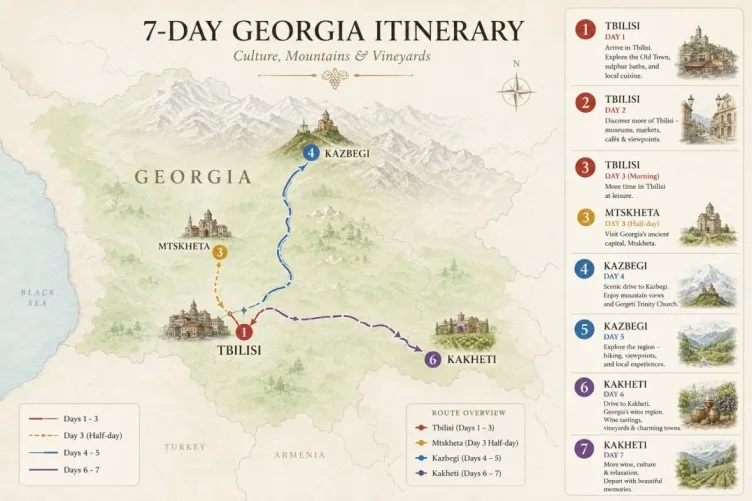
Days 1 to 3: Tbilisi
Day 1: Arrive, check in to Old Town accommodation, walk Shardeni Street and the river embankment in the evening. First Georgian dinner (khinkali and lobiani), first glass of amber wine.
Day 2: Morning at the sulphur baths (book a private room in advance). Afternoon at Narikala Fortress via cable car from Rike Park. Evening walk through Rustaveli Avenue, Tbilisi’s main boulevard, and the Liberty Square area.
Day 3: Morning at the Dry Bridge Market (excellent for silver jewellery, Soviet-era objects, and handmade ceramics). Afternoon half-day trip to Mtskheta (Svetitskhoveli Cathedral and Jvari Monastery). Return to Tbilisi for dinner.
Days 4 to 5: Kazbegi
Day 4: Morning shared marshrutka or private transfer to Kazbegi along the Georgian Military Highway (the drive through the Jvari Pass is one of the finest road journeys in the Caucasus). Arrive by early afternoon. Walk to Gergeti Trinity Church.
Day 5: Full day in the mountains. Options: hike to Gergeti Glacier (strenuous, 6 to 7 hours, requires a guide), walk the valley floor trails above the town (easier, no guide required), or simply sit at the viewpoint above the church watching Mount Kazbek catch the afternoon light, which is, genuinely, an entirely valid way to spend a day here. Return to Tbilisi by evening if continuing the itinerary.
Days 6 to 7: Kakheti
Day 6: Drive or bus to Sighnaghi (2 hours from Tbilisi). Check in to a guesthouse with valley views. Afternoon walk through the walled town. Evening wine tasting at a local family winery.
Day 7: Morning at Bodbe Monastery. Visit to a larger winery for a formal tasting (Twins Wine House or Schuchmann). Late afternoon return to Tbilisi for a final evening in the city before departure.
This itinerary is achievable without a car (public transport and shared transfers handle all the connections) and works well as a solo itinerary at every stage.
Part Eight: Georgia and the Bigger Women’s Travel Picture
For the woman who has been building her solo travel confidence through domestic destinations before making the international leap, Georgia is one of the finest possible first international solo trips. It has the right combination of genuine difference (language, food, landscape, culture entirely unlike India) and practical accessibility (straightforward visa, direct flights, safe urban environment, English-speaking tourist infrastructure in the main areas).
As noted in our international solo travel guide, the first international solo trip should be chosen for confidence-building rather than for proving a point. Georgia builds confidence efficiently because almost everything works as expected, leaving cognitive space to actually experience and enjoy the place rather than spending it troubleshooting logistics.
For the woman who has already done Kerala and wants to go further, or who has travelled the Himalayan temple villages of Uttarakhand and wants a mountain experience with an entirely different cultural register, or who found herself energised by the Triyuginarayan experience and wants to apply that same quality of slow, present attention to a new country, Georgia is the natural next step.
Travel is not a reward you earn after everything else is sorted. It is the sorting. Go while there is still something to discover. Georgia, right now, qualifies.
🧞 Real Shee Power Genie Says
“Georgia is the trip you take when you are ready to trust yourself a little more than you did before. It will not disappoint you. And it will not leave you unchanged. Both of those things are the point.”
Conclusion: The Crossroads Was Always There. You Just Did Not Know to Look.
Georgia has been at the crossroads of civilisations for five thousand years. Persians, Romans, Mongols, Ottomans, Russians, and Soviets have all left their mark on a country that absorbed each influence without losing the thread of its own identity. The result is a culture of extraordinary layered depth: ancient Christian tradition alongside Soviet-era brutalist architecture alongside ultramodern design hotels alongside women in kerchiefs making bread in wood-fired ovens in 12th-century villages.
To travel in Georgia is to be continuously surprised by what sits beside what. And for women who have been told that the world is dangerous and that staying home is wise, Georgia offers a gentle but direct refutation. The world is vast and much of it is hospitable and the sulphur baths of Abanotubani have been warm and waiting for fifteen hundred years.
Book the ticket. Get the e-Visa. Arrive hungry and curious.
Georgia will handle the rest.
Continue reading the Real Shee Power Travel Series: 🔗 She Packed One Bag And Got Her Whole Life Back: International Solo Travel for Women 🔗 That Horse Riding Reel From Kazakhstan Is Real 🔗 She Rode Into the Horizon: Horse Riding Travel for Women 🔗 India’s Safest Hidden Destinations for Women Travellers 🔗 Kerala for Women Travellers 🔗 Triyuginarayan: A Feminine Healing Journey in Uttarakhand 🔗 Mystical Himalayan Temples Hidden Above the Clouds 🔗 The Ultimate Goa Travel Guide 2026 🔗 The Soul of the Côte d’Azur of the East: Puducherry 2026 🔗 Epic Himalayan Trek That Will Change You Forever 🔗 Solo Travel Tag 🔗 Adventure Tag 🔗 Travel Guide Tag
Disclaimer: Visa requirements, entry rules, and travel conditions change. Always verify current requirements at the official Georgian e-Visa portal (evisa.gov.ge) and through the Embassy of Georgia or your airline before booking. All visa information in this article reflects conditions as of July 2026. Travel insurance with a minimum of 30,000 GEL emergency coverage is mandatory for entry into Georgia as of January 1, 2026.