The Sun, the River, and the Unbroken Vow: 10 Fascinating Wonders of Chhath Puja
Quick Summary: Chhath Puja Overview
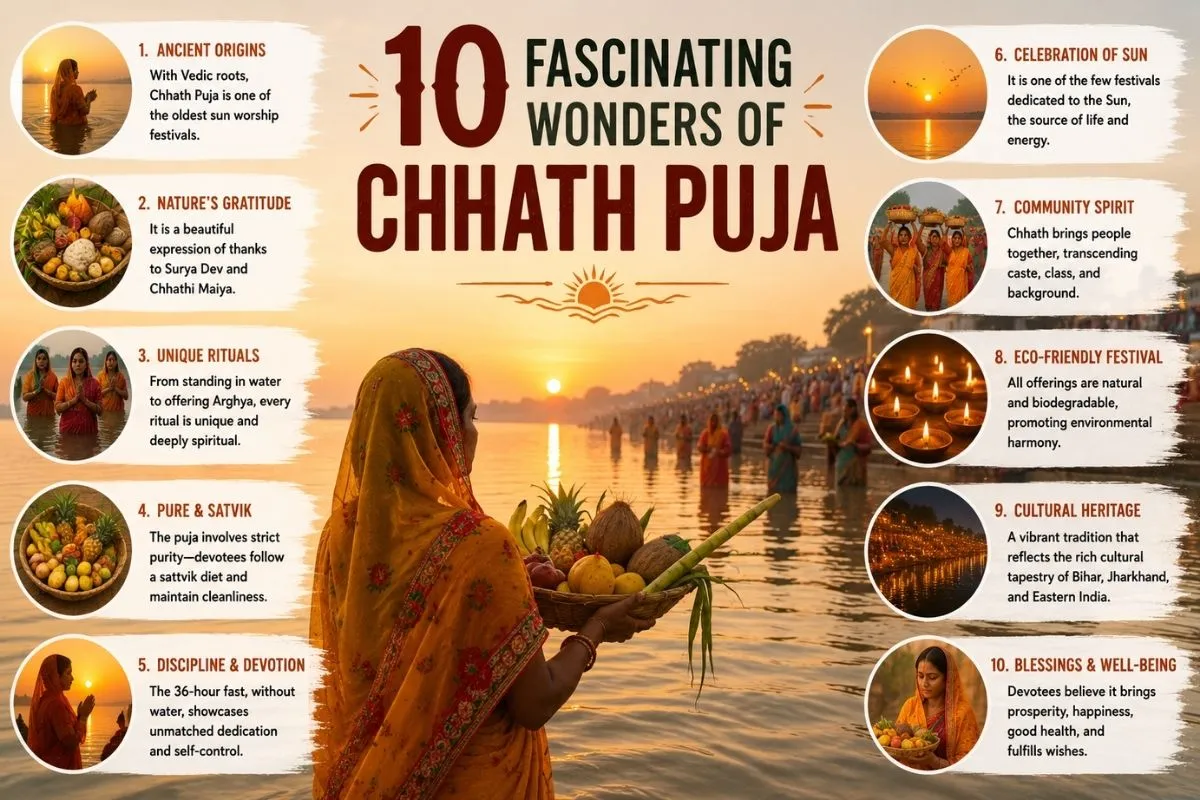
An ancient four-day Vedic festival dedicated to the Sun God and Chhathi Maiya.
- Unique Rituals: Features prayers to both the setting sun and the rising sun while standing waist-deep in natural water bodies.
- Extreme Endurance: Involves a 36-hour dry fast (Nirjala) observed without food or water.
- Egalitarian & Direct: Celebrated without idols, priests, or grand temples—connecting devotees directly to nature.
- Eco-Friendly & Sustainable: Relies entirely on natural, biodegradable materials like bamboo baskets, clay stoves, and local organic produce.
- Signature Offering: Known for “Thekua,” a traditional sweet wheat-and-jaggery prasad cooked on earthen stoves.
Every autumn, as the harvest winds begin to sweep across Northern and Eastern India, millions of people prepare for one of the most rigorous, ancient, and deeply reverent festivals in human history. Chhath Puja, dedicated to the Sun God (Surya) and his divine sister Chhathi Maiya, stands apart in the global tapestry of cultural celebrations.
It is a festival where there are no priests to mediate between the devotee and the divine. There are no elaborate temple rituals, no grand idols of gold, and no requirements for high-born privilege. Instead, it is a direct, egalitarian dialogue between humanity and nature.
Beyond its deep spiritual warmth, Chhath Puja is packed with surprising traditions, scientific marvels, and rich folklore. From setting suns to zero-waste practices, here are the captivating stories and fun facts that make Chhath Puja an enduring phenomenon.
Fact 1: Praying to the Setting Sun First
In almost every sun-worshiping culture across ancient history, from the Egyptians to the Incas, prayer was offered exclusively as the sun rose, welcoming light and energy into the morning. Chhath Puja flips this script in a profound, poetic way.
On the third day of the four-day festival, known asSandhya Arghya, millions of devotees stand waist-deep in river waters to offer prayers to thesetting sun. Only on the following morning, duringUsha Arghya, do they welcome the rising sun.
Philosophically, this ritual carries a powerful message: society often celebrates rising power, success, and beginnings, but Chhath teaches us to honor the setting light, old age, and the endings that make new beginnings possible. It acknowledges that the sun which sets today is the very same sun that brings life tomorrow.
Fact 2: The Only Major Hindu Festival Without Temple Idols or Priests
Walk along the banks of the Ganges during Chhath, and you will notice something missing: there are no temple priests leading prayers, no mantras chanted through loudspeakers by clergy, and no elaborate painted statues installed under grand canopies.
Chhath Puja is completely decentralized and direct. The principal deity is the visible sun itself—Pratyaksha Devata—the physical star that sustains all life on Earth. The offerings are prepared entirely by the family, and the rituals are performed directly by the fasting devotee, known as theVratinorParvaitin.
By removing intermediary priesthoods, Chhath has remained one of the most egalitarian festivals in the world for centuries. Men and women from every walk of life stand side-by-side in the same river waters, offering identical homemade prasad to the exact same sky.
Fact 3: The Incredible 36-Hour Fast Without Water
While many festivals feature fasting, the physical commitment required during Chhath Puja is legendary. The festival spans four continuous days, building up to a grueling 36-hour period known asNirjala—meaning “without a single drop of water.”
The journey unfolds in four distinct stages:
- Nahay Khay (Day 1):Devotees bathe in holy rivers or clean water sources, clean their entire household, and prepare a simple, purified meal of bottle gourd curry and unpolished rice cooked in brass or earthen utensils.
- Kharna (Day 2):The devotee fasts all day, breaking it only in the evening after sunset with a prasad ofRasiya(jagrery kheer) and hand-rolled chapatis. This is the last food or water the devotee will take for the next day and a half.
- Sandhya Arghya (Day 3):The 36-hour dry fast begins in full force. The devotee spends the entire day preparing offerings, carrying heavy bamboo baskets (SoopandDaura) to the riverbank, and standing in cold water as the sun sets.
- Usha Arghya (Day 4):Before dawn breaks, devotees return to the riverbank, standing again in the water to wait for the first rays of the morning sun. Once the morning offering is complete, the fast is finally broken with fresh ginger, raw sugar, and prasad.
Despite the intense physical challenge, devotees report feeling an incredible sense of mental calm and spiritual elevation rather than fatigue, attributing their endurance to the strength granted by Chhathi Maiya.
Fact 4: Who Exactly is Chhathi Maiya?
While prayers are offered to the Sun God (Surya Dev), the songs echoing along the riverbanks are overwhelmingly dedicated toChhathi Maiya. Who is this beloved deity?
According to ancient Vedic lore, Chhathi Maiya isShashti Devi, the sixth form of Prakriti (Nature) and the spiritual sister of Surya. She is revered as the protector of children, the giver of offspring, and the guardian of family longevity.
Mythology holds that when a child is born, Shashti Devi visits on the sixth day to bless the newborn with health and destiny. During Chhath Puja, mothers and grandmothers pray to her with fierce devotion, asking her to protect their children from harm, illness, and hardship.
Fact 5: The Science of Standing in Water at Dawn and Dusk
While Chhath is rooted in faith, its core practices align fascinatingly with seasonal bio-rhythms and light therapy.
Standing waist-deep in water during sunset and sunrise exposes the body to soft, long-wavelength solar radiation. During early morning and late evening, ultraviolet (UV) radiation is at its lowest, while beneficial infrared rays are at their highest.
Ancient practitioners recognized that receiving sunlight through the eyes and skin while grounded in natural water bodies helped balance the nervous system, stimulate the pineal gland, and boost immunity just as the cold winter season sets in. The 36-hour fast further aids cellular detoxification, allowing the body to reset naturally before the deep winter months.
Fact 6: An Ancient Legacy Running from Rama to Karna
The roots of Chhath Puja stretch back thousands of years, weaving through India’s greatest epics:
- The Legend of Karna:In the Mahabharata, Karna—the legendary warrior and king of Anga (modern-day Bhagalpur in Bihar)—was the son of the Sun God Surya. He was famous for standing in the river every single day to offer prayers to his father and distribute gifts to the poor. Many believe the tradition of offeringArghyain river waters originated with him.
- The Pandavas and Draupadi:During their long exile in the forest, when the Pandavas faced severe hardships and food shortages, Draupadi performed deep penance to Surya Dev under the guidance of Sage Dhaumya, securing a divine vessel (Akshaya Patra) that provided infinite food.
- Lord Rama and Sita:In the Ramayana, upon returning to Ayodhya after fourteen years of exile and defeating Ravana, Lord Rama and Queen Sita observed a fast and performed sun worship during the month of Kartik to give thanks and establish a prosperous reign.
Fact 7: The Masterclass in Zero-Waste, Sustainable Living
Long before “eco-friendly” and “zero-waste” became global buzzwords, Chhath Puja built environmental sustainability directly into its spiritual DNA.
Every single element used in Chhath Puja comes straight from nature and returns to nature:
- Bamboo Baskets (SoopandDaura):Plastic and processed metals are strictly forbidden. All offerings are carried in handcrafted bamboo baskets woven by traditional artisans.
- Earthen Stoves (Chulha):The special prasad is cooked outdoors on mud stoves fueled by dried mango wood and cow dung cakes.
- Seasonal Harvest Offerings:The offerings consist entirely of seasonal, unrefined produce—sugarcane stalks with leaves intact, raw turmeric, ginger plants, pomelo (Gaggar Nimbu), water chestnuts (Singhara), sweet potatoes, coconuts, and green banana clusters.
- Clay Lamps (Dia):Illumination along the riverbanks comes from natural clay oil lamps, leaving no toxic waste behind in the water bodies.
The festival acts as a seasonal tribute to the local agricultural economy, ensuring that small farmers, pottery makers, and bamboo weavers receive direct economic support ahead of the winter season.
Fact 8: The Culinary Sacredness of Thekua
No discussion of Chhath Puja is complete without mentioning its undisputed culinary hero:Thekua.
Thekua is a traditional, sweet whole-wheat cake made by combining stone-ground wheat flour, melted jaggery (or unrefined sugar), ghee, fennel seeds, and crushed cardamom. The dough is pressed into carved wooden molds (Embossed Blocks) featuring leaf or floral patterns, and deep-fried in pure ghee over an earthen stove.
The preparation of Thekua demands absolute cleanliness. The wheat is washed, dried under the sun while being guarded against birds, and ground separately. The resulting sweet treat is not only delicious, with a crunchy exterior and aromatic spice notes, but it is also a dense energy bar designed to sustain the family and pilgrims throughout the long festival days.
Fact 9: A Global Festival Carried Across Oceans
While Chhath Puja originated in the Mithila, Bhojpur, and Magadh regions of Bihar, Jharkhand, and Eastern Uttar Pradesh, it has expanded far beyond its regional roots.
In recent decades, migration has turned Chhath into a global celebration. On the days of Chhath, you can see vibrant gatherings along the banks of the Yamuna in New Delhi, the beaches of Mumbai, and artificial ponds built across global hubs.
From the banks of the Hudson River in New York and the beaches of Fiji and Mauritius, to public parks in London, Sydney, and Toronto, diaspora communities gather in traditional attire, singing age-old folk melodies in Bhojpuri, Maithili, and Magahi to greet the sun.
Honor, Devotion, and Gratitude
At its heart, Chhath Puja is a celebration of ultimate gratitude. It asks for no personal luxury, requires no commercial excess, and leaves behind no harm to the Earth.
It is a quiet, powerful reminder that humanity is inextricably bound to the natural world. As long as the sun continues to shine and the rivers continue to flow, the spirit of Chhath will live on—a timeless vow of faith, endurance, and love passed down across generations.