Tarot for Beginners: How Real Is It? Let’s Find Out
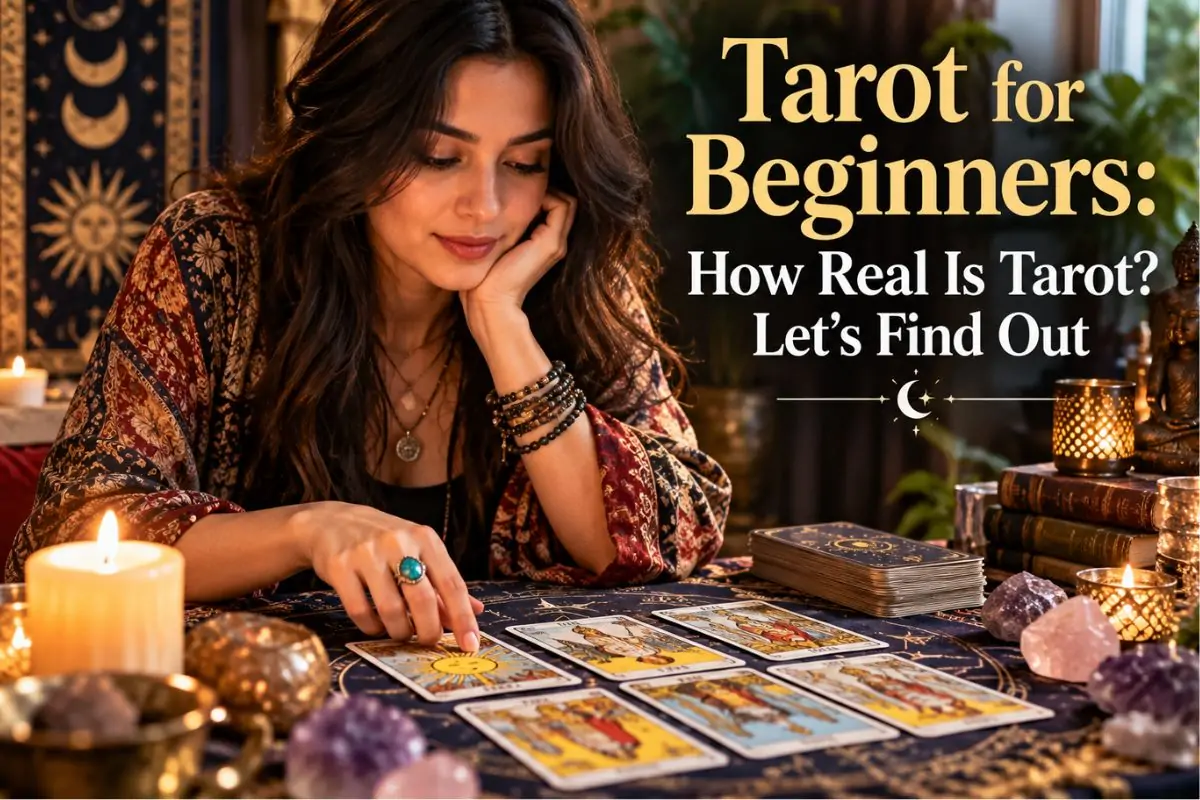
Can a deck of 78 cards reveal your future, expose someone’s true feelings, or tell you what the universe has planned? We investigate tarot without the complicated jargon, the scary predictions, or the unnecessary drama.
Imagine sitting across from a tarot reader. They shuffle a deck, ask you to think about your question, and turn over three cards.
The first represents your past. The second supposedly explains your present. The third hints at your future.
Then the reader says something oddly specific about your life.
You freeze.
How could a stranger possibly know that?
Is it intuition? Spiritual energy? Coincidence? Or is your brain connecting the dots in ways you have never noticed?
Welcome to the fascinating world of tarot. You do not need to believe in magic to understand it, and you certainly do not need to spend a fortune on a reading. Let’s learn how it works, try a simple reading, and examine the big question:how real is tarot, actually?
Table of Contents
1. First, What Exactly Is Tarot?
Tarot is a deck of 78 illustrated cards that people use for divination, spiritual practice, storytelling, and personal reflection.
The cards feature striking imagery: a mysterious woman seated between two pillars, a tower struck by lightning, a figure carrying a lantern, lovers standing beneath an angel, and even a card called Death.
Naturally, some of these images look rather dramatic. But their meanings are usually symbolic, not literal.
According to the Victoria and Albert Museum, tarot began as a card game in Renaissance Italy. Its association with fortune-telling developed centuries later, particularly from the late eighteenth century onward.
Today, tarot readers interpret the cards in different ways. Some believe they offer spiritual guidance or reveal hidden influences. Others treat them as prompts for examining emotions, relationships, and decisions.
The deck itself does not come with scientifically established powers. What people believe a reading means depends on their spiritual worldview and how they interpret the cards.
2. The Tarot Deck Has Two Main Parts
You do not need to memorise all 78 cards to understand a basic reading. Start with the two main groups.
The Major Arcana: 22 cards
These cards are often associated with major themes, turning points, and personal growth.
A few examples:
- The Fool:New beginnings, taking a chance, or stepping into the unknown.
- The Lovers:Relationships, connection, or an important choice.
- The Tower:Disruption, sudden change, or the collapse of something unstable.
- The Star:Hope, renewal, and optimism.
- Death:Endings, transitions, and transformation, not a literal prediction that someone will die.
The Minor Arcana: 56 cards
These cards are divided into four suits, commonly called Wands, Cups, Swords, and Pentacles.
A beginner-friendly way to understand them is:
- Wands:Action, ambition, creativity, and energy.
- Cups:Feelings, relationships, and emotional experiences.
- Swords:Thoughts, communication, conflict, and decisions.
- Pentacles:Money, work, practical matters, and material security.
These are common modern interpretations, not universal rules. Different tarot traditions and readers may assign slightly different meanings.
3. How Does a Tarot Reading Actually Work?
Here is the basic process.
You ask a question. The reader shuffles the deck and draws cards. Each card is placed in a particular position, and the reader interprets its imagery and traditional meaning in relation to your question.
For example, you might ask, “What should I consider before changing jobs?”
The reader draws three cards:
- Card one, the present:What is happening now?
- Card two, the challenge:What might be making the decision difficult?
- Card three, the next step:What could you consider doing?
A reader might interpret the cards as a sign that you want change, fear uncertainty, and need to examine your finances before making a decision.
Notice something important: this reading does not actually establish whether you will get a new job. Instead, it gives you a framework for thinking about your circumstances.
Some readers believe the cards are guided by spiritual forces or meaningful coincidences. Others see the process as a combination of symbolism, intuition, and reflection.
The same reading can therefore mean different things to different people.
4. Let’s Try a Simple Tarot Reading Right Now
You do not need a physical deck for this demonstration. Consider the following three cards and their common interpretations.
🔮 Let’s Try a Simple Tarot Reading

Card 1: The Fool
Theme: A new beginning
The Fool is often associated with starting something unfamiliar, taking a risk, or approaching life with curiosity. As a reflection prompt, it asks whether you are ready for a new experience and whether you have considered the risks.

Card 2: The Hermit
Theme: Reflection and solitude
The Hermit often represents stepping back from noise to think clearly. It can prompt you to consider whether you are listening to your own judgement or letting other people’s opinions make the decision for you.

Card 3: The Star
Theme: Hope and renewal
The Star is commonly associated with optimism, healing, and renewed confidence. It can encourage you to consider what would help you move forward with a clearer sense of direction.
Remember: These are traditional symbolic interpretations, not scientifically verified predictions of your future.
Together, these cards could tell a story about beginning something new, taking time to understand yourself, and moving forward with hope.
That sounds meaningful, doesn’t it?
But here is the crucial distinction:a meaningful interpretation is not the same as proof of a supernatural prediction.These cards did not establish what will happen in your future. They offered themes you can use to think about it.
5. Why Does Tarot Sometimes Feel Unbelievably Accurate?
This is where psychology gets interesting.
Imagine a reader tells you, “You are a strong person, but sometimes you feel misunderstood. You care deeply about others, although you occasionally need to protect your own energy.”
You might immediately think, “That is exactly me!”
But the description could resonate with many people. It is broad enough to fit a wide range of personalities and circumstances.
Psychologists call one relevant phenomenon theBarnum effect, the tendency to regard general personality descriptions as uniquely accurate descriptions of ourselves. Research on psychic readings has also discussed how suggestion, selective attention, and confirmation bias can influence what people perceive as an accurate reading.
Three things can help explain the experience:
You remember the hits.If a reader makes ten statements and two feel remarkably accurate, those two may dominate your memory.
You interpret vague language personally.A card associated with “change” could refer to a job, a friendship, a move, or an internal shift. You supply the context from your own life.
You notice what confirms your expectations.If you already suspect that a relationship is changing, a card about uncertainty may feel like powerful confirmation. You may pay less attention to interpretations that do not fit.
None of this means tarot readers are necessarily dishonest or that every meaningful experience is imaginary. It means that a feeling of accuracy, by itself, cannot prove that the cards have access to hidden information.
6. Can Tarot Really Predict the Future?
Let’s separate belief from evidence.
People have used tarot to explore questions about love, careers, money, marriage, and major life changes. Some report readings that seemed remarkably specific or came true later.
However,there is not enough robust, independently replicated scientific evidence to establish that tarot cards can reliably predict future events through supernatural means.The research base directly testing tarot’s predictive accuracy is limited.
There is an important distinction between two claims:
- “This card helped me think differently about my relationship.”
- “This card reliably revealed what another person secretly feels and what they will do next month.”
The first is a personal experience that can be useful. The second is a factual claim about information and prediction, and it requires stronger evidence.
To test predictive ability properly, researchers would need clearly defined predictions recorded before the outcomes occur, objective scoring rules, suitable comparisons, and independent replication.
Without those safeguards, it is easy to interpret events after the fact in a way that makes a prediction appear correct.
So, can tarot tell you exactly when you will marry, whether your ex will return, or which career decision will make you wealthy? There is no reliable scientific basis for treating a reading as a dependable answer to those questions.
7. What About Tarot Cards That Look Frightening?
Few cards have a worse public relations problem than Death and The Tower.
The Death card is commonly interpreted as an ending, transition, or transformation. The Tower often represents disruption, upheaval, or the collapse of an existing structure.
Neither card establishes that something terrible will happen.
For example, a reader might interpret The Tower as a prompt to examine a situation that feels unstable. That can be a useful invitation to reflect. It is not evidence that you will lose your job, experience a breakup, or face a disaster.
The same caution applies to cards interpreted as warnings about betrayal, illness, or financial loss.
A reader cannot establish that a partner is cheating, that a medical condition is present, or that a financial crisis is inevitable simply by drawing a card.
If a reading frightens you, remember that a symbolic interpretation is not a verified forecast. You are not required to make major decisions because a card has appeared.
8. Can You Use Tarot Without Believing in Magic?
Absolutely.
Think of tarot as a deck of illustrated prompts. Each card presents a theme, and that theme gives you an opportunity to examine something you might otherwise overlook.
Suppose you draw a card traditionally associated with conflict. Rather than concluding that an argument is coming, you could ask yourself:
- Is there a conversation I have been avoiding?
- Am I making assumptions about someone else’s intentions?
- Is there a problem I could address calmly instead of ignoring it?
Or suppose you draw a card associated with new beginnings. You might consider what you want to change, what is stopping you, and which practical step you can take this week.
The value comes from the thinking you do, not from assuming that the card knows something you do not.
Tarot is not the only way to do this. Journaling, meditation, talking to a trusted friend, or working through a decision with a structured list can serve similar purposes.
9. How to Try Tarot Without Getting Misled
If you are curious, there is nothing wrong with exploring tarot as a cultural, spiritual, or reflective practice. The key is to keep your expectations realistic.
Start with one question.Choose something open-ended, such as “What should I consider about my career?” Avoid treating the cards as a guaranteed yes-or-no prediction.
Learn the basic meanings.Begin with a few familiar cards rather than trying to memorise the entire deck in one sitting.
Write down your interpretation.Record what you think the card means before looking for someone else’s explanation. This helps you see how your own experiences influence the reading.
Keep track of predictions.If someone claims a specific event will happen, write down the exact claim and its timeframe before the outcome is known. This is more reliable than remembering only the predictions that seem to come true.
Be careful with money.A reader who repeatedly insists that you need additional paid sessions to remove a curse, prevent a disaster, or secure someone’s love is giving you a reason to step back.
Most importantly, do not use tarot as a substitute for medical care, legal advice, financial planning, or direct communication with the people in your life.
You can be curious without handing over your judgement.
10. So, Is Tarot Real? Here Is Our Verdict
The answer depends on what you mean byreal.
Tarot is real as a historical practice, a visual art form, a spiritual tradition, and an experience that many people find personally meaningful. Its imagery can prompt reflection, and a reading may help someone organise thoughts or approach a difficult question from a different angle.
But if the question is whether tarot has been scientifically demonstrated to reveal hidden truths or reliably predict future events, the evidence does not establish that claim.
That does not mean every person who finds value in tarot is foolish. It means we should distinguish between personal meaning and independently verifiable knowledge.
You can enjoy the mystery, appreciate the symbolism, and explore what a card makes you think about without treating it as a command from the universe.
And perhaps that is the most useful way to approach tarot: stay curious, ask questions, and keep your feet firmly on the ground.
The cards may offer you a story. You still get to decide what you do with it.