The Honest Guide to Sunscreen in India: SPF, PA Ratings, White Cast, and the Reapplication Myth Nobody Follows
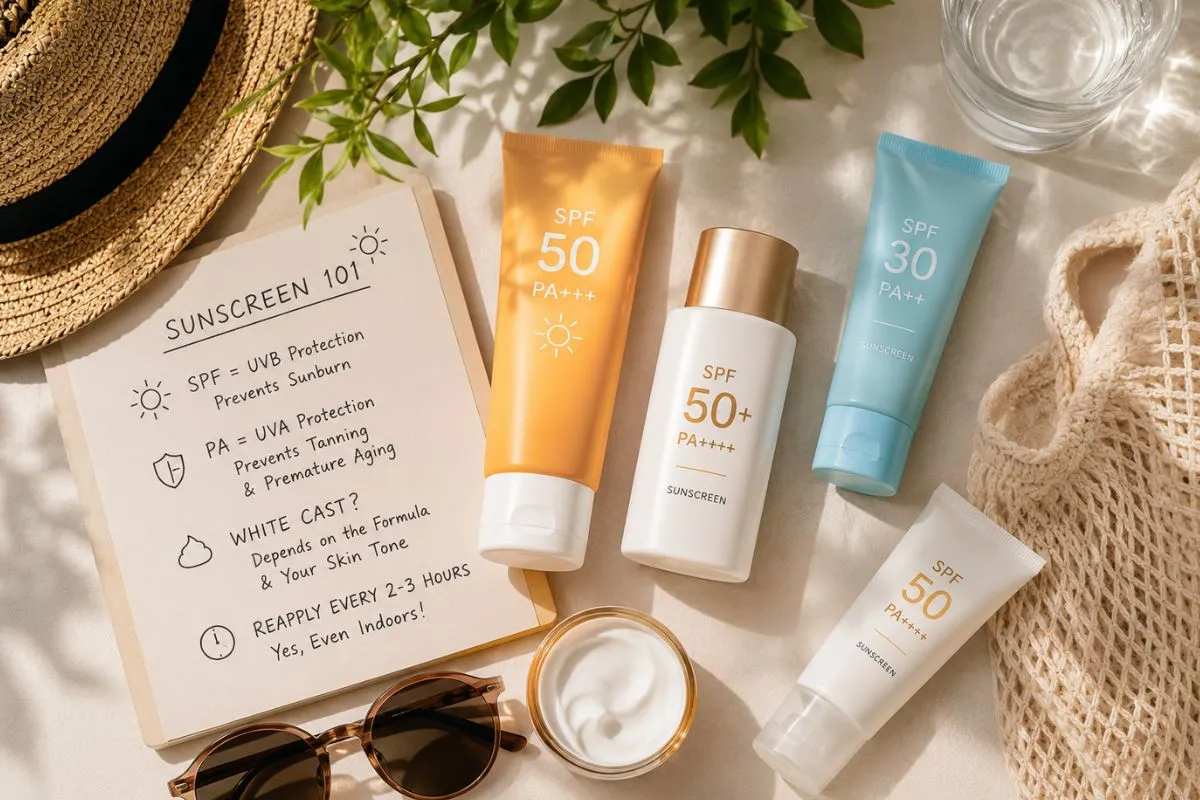
There is a strange gap between what Indian women know about sunscreen and what they actually do with it. Almost everyone has heard “wear SPF every day.” Fewer people can explain what SPF is actually measuring, why a bottle labeled SPF 50 might still let in more damage than a well applied SPF 30, or why the PA rating sitting quietly next to the SPF number on Korean and Japanese sunscreens matters just as much, sometimes more.
This is not another listicle telling you to “never skip sunscreen.” You already know that. This is the guide that actually explains the numbers, clears up the white cast panic that keeps so many Indian women skipping sunscreen altogether, and gives you a realistic reapplication routine that fits an actual working day instead of a dermatologist’s ideal one.
Why Sunscreen Still Beats Every Serum on Your Shelf
Skin is the body’s largest organ, and it is remarkably honest about how it has been treated. As we explored in Glow Is Not a Product. It Is a Report Card, the condition of your skin reflects your gut, your hormones, your sleep, and your sun exposure long before any serum gets a chance to intervene. Of all the variables in that list, sun exposure is the one you have the most daily control over, and it is also the single biggest driver of visible aging.
Roughly eighty percent of visible facial aging (fine lines, uneven tone, loss of elasticity, pigmentation) is linked to cumulative UV exposure rather than the passage of time itself. Retinol, vitamin C, and peptides all work by encouraging your skin to repair damage. Sunscreen works by preventing damage from happening in the first place. Prevention will always require less effort than repair, which is exactly why our piece on Skin Minimalism calls sunscreen the one genuinely non-negotiable step in any routine, no matter how pared down the rest of it gets.
India adds its own layer of urgency to this. Most of the country sits close enough to the equator that UV index readings regularly cross into the “very high” and “extreme” categories for much of the year, even on days that feel overcast. Cloud cover blocks visible light, not UV radiation, which is why so many people get sunburned on grey monsoon afternoons and wonder how it happened.
SPF, Actually Explained
SPF stands for Sun Protection Factor, and it measures protection against UVB rays specifically, the type responsible for sunburn and a major contributor to skin cancer risk. The number tells you, in theory, how much longer it would take your skin to burn with the sunscreen on compared to bare skin.
Here is the part most sunscreen marketing conveniently leaves out: the jump in protection between SPF numbers is not linear, and it flattens out fast.
- SPF 15 filters out roughly 93 percent of UVB rays
- SPF 30 filters out roughly 97 percent
- SPF 50 filters out roughly 98 percent
- SPF 100 filters out roughly 99 percent
The difference between SPF 30 and SPF 50 is genuinely small in percentage terms. The difference between applying a thin, stingy layer and applying a proper, generous one is enormous. Most people apply less than half the amount used in laboratory testing to achieve the SPF number printed on the bottle, which means a real world SPF 50 applied thinly often performs closer to an SPF 15 or 20. Buying a higher number is not a substitute for applying enough of it.
PA Ratings: The Number Your Sunscreen Might Be Missing Entirely
SPF tells you nothing about UVA protection, and UVA is the ray responsible for deeper, cumulative damage: wrinkles, sagging, and the stubborn pigmentation and melasma that so many Indian women struggle with. This is where PA ratings come in.
Developed in Japan and now standard across Korean and Japanese sunscreens, the PA (Protection Grade of UVA) system uses a plus scale:
- PA+ offers some UVA protection
- PA++ offers moderate protection
- PA+++ offers high protection
- PA++++ offers the highest available protection
A sunscreen with SPF 50 but no PA rating, or a low one, is doing a great job stopping sunburn while doing very little about the pigmentation and premature aging that actually bother most people long term. This is a genuine gap in a lot of Western sunscreen formulations, since the American FDA does not require a PA equivalent on its labels. If pigmentation, melasma, or uneven tone is your main concern rather than sunburn, look specifically for PA+++ or PA++++, not just a high SPF number.
Chemical, Mineral, or Hybrid: Cutting Through the Confusion
Chemical (organic) filters like avobenzone, octinoxate, and the newer Tinosorb range absorb UV radiation and convert it to heat, which is then released from the skin. Mineral (inorganic) filters like zinc oxide and titanium dioxide sit on the skin’s surface and physically reflect or scatter UV rays.
The internet has turned this into a moral debate, with mineral sunscreen positioned as “clean” and chemical sunscreen treated with suspicion. The actual science is far less dramatic. Both categories are considered safe and effective when properly formulated, and the real differences that matter for daily wear are practical, not ideological:
- Mineral sunscreens sit on top of the skin and can leave a visible white or grey cast, particularly on medium to deep skin tones, unless the formula uses micronized or tinted zinc oxide
- Chemical sunscreens tend to absorb more invisibly but can occasionally irritate very sensitive or reactive skin
- Hybrid formulas, which combine both filter types, have become the most popular category in 2026 precisely because they balance cosmetic elegance with broad protection
If your skin reacts badly to fragrance or certain preservatives, mineral formulas are usually the gentler starting point. If white cast has made you avoid sunscreen altogether, a well formulated chemical or hybrid sunscreen is very likely the fix, not a reason to skip SPF entirely.
The White Cast Problem, Solved Honestly
This deserves its own section because it is the single biggest reason Indian women skip sunscreen. Nobody wants to look ashy in photos, and older mineral formulations genuinely did leave a chalky finish on medium and deep skin tones.
The good news is that sunscreen formulation has moved on considerably. A few practical fixes:
- Look for “invisible,” “sheer,” or “tinted” on mineral sunscreen labels. Newer micronized zinc oxide particles are small enough to avoid the thick white film older formulas were known for.
- Try tinted sunscreens as your base makeup. Several 2026 launches now double as a light coverage base, which solves the white cast problem by design rather than by accident.
- Give it a few minutes before judging the finish. Many sunscreens oxidize or settle into a more natural tone within five to ten minutes of application, and judging the cast immediately after applying is one of the most common reasons people give up too early.
- If you have deeper skin, chemical or hybrid formulas will almost always be the more forgiving choice over pure mineral ones.
The Reapplication Myth Nobody Actually Follows
Dermatologists recommend reapplying sunscreen every two hours of direct sun exposure. Almost nobody working a desk job, running errands, or commuting actually does this, and the guidance rarely accounts for how differently people actually spend their day. Here is a more realistic breakdown.
If you are indoors most of the day, away from windows: One generous morning application is usually sufficient, since UV exposure through walls is negligible. If your desk sits near a window, treat that as partial outdoor exposure and reapply around midday.
If you are indoors but near windows or in a car often: UVA rays pass through glass even when UVB mostly does not. This is a major, underappreciated source of the pigmentation that shows up more on the side of the face and arm closest to a car window. A midday touch up is worth the thirty seconds it takes.
If you are outdoors for meaningful stretches: The two hour rule genuinely applies. Carry a compact sunscreen stick or spray for reapplication over makeup, since most people abandon reapplication simply because rubbing in a cream over a full face of makeup feels impossible.
If you are in a pool or sweating heavily: Reapply immediately after, regardless of whether the sunscreen claims water resistance. Water resistant means it holds up for a stated number of minutes of water exposure, not that it lasts indefinitely.
Layering Sunscreen With Makeup Without Ruining Either
A common complaint is that sunscreen pills, balls up, or fights with foundation. A few things genuinely help. Let the sunscreen absorb fully, ideally two to three minutes, before applying anything else. Thin, even layers work better than one thick coat both for sunscreen efficacy and for how well makeup sits on top afterward.
If you enjoy a cooling, depuffing prep step before base makeup, a caffeine based sculpting mask can actually help sunscreen and foundation sit more smoothly by tightening and smoothing the surface first. Our full review of Rhode’s Caffeine Reset Sculpting Cream Mask covers exactly how it performs as a pre makeup step, including how it holds up under sunscreen and foundation layered on top.
On the makeup side, foundations that are genuinely built for Indian skin and climate tend to wear better over sunscreen than ones designed for cooler, drier markets. Our honest breakdown in NARS Cosmetics: Luxury, Hype, and the Brutal Truth About What’s Actually Worth It covers which of their bases actually survive humidity and layering without breaking down by afternoon.
Sunscreen Through the Indian Calendar
India’s climate is not one thing, and your sunscreen strategy should shift with it. Summer calls for lightweight, matte leaning, high SPF formulas that can handle sweat and oil without sliding off. Monsoon humidity makes water resistant, non greasy formulas essential, since sunscreen mixed with sweat and moisture is one of the most common causes of monsoon breakouts. Winter, particularly in northern India, brings a false sense of security: UV index can remain high even in cooler, hazier weather, and dry indoor heating makes hydrating sunscreen formulas more comfortable to wear. Air conditioned offices, which most working women spend the bulk of their day in, do not eliminate the need for sunscreen, since window exposure and the drying effect of AC both still apply.
If you have already read Does the 10-Step K-Beauty Routine Actually Work in India?, you will recognize this theme: a routine built for one climate rarely transfers perfectly to another, and sunscreen is the step most affected by that mismatch. A rich, ceramide heavy sunscreen formulated for Korean winters can feel unbearably heavy during a Mumbai monsoon, while a featherlight, alcohol forward gel formula built for humid climates may not offer enough comfort during a dry Delhi winter.
Budget Versus Luxury: Where the Money Actually Matters
Sunscreen is one of the few categories in beauty where an expensive price tag correlates weakly, if at all, with actual UV protection. A well formulated ₹400 sunscreen and a ₹3,500 one can offer identical SPF and PA protection, with the price difference reflecting texture, finish, and brand experience rather than efficacy. Our deeper look at Are India’s High-End Beauty Brands Actually Worth the Splurge? makes a similar point about the broader luxury skincare category: premium pricing sometimes buys real performance and sometimes buys ritual and sensory pleasure, and it is worth knowing which one you are actually paying for.
Where it can genuinely make sense to spend more on sunscreen specifically is texture and wearability. If a cheaper formula sits so heavily or looks so ashy that you stop using it after two weeks, the expensive one you actually apply every single day is the better investment, simply because consistency is what protects your skin, not the price on the label.
Common Sunscreen Myths, Retired
“I have dark skin, I don’t burn, so I don’t need sunscreen.” Melanin does offer some natural UV protection, but it is nowhere near enough on its own. Deeper skin tones are still highly prone to UV triggered pigmentation, melasma, and premature aging, even without visible sunburn.
“I’m indoors all day, so it doesn’t matter.” Covered above, but worth repeating: UVA passes through glass, and most Indian offices and homes have plenty of window exposure across a full day.
“Higher SPF means I can apply less or skip reapplication.” SPF numbers assume a specific, generous application amount in testing. A higher number applied thinly still underperforms.
“Sunscreen causes breakouts.” Some formulas do, usually due to heavy, occlusive, or comedogenic ingredients rather than sunscreen filters themselves. The fix is switching formulas, specifically toward gel or fluid textures for oily or acne prone skin, not skipping sun protection altogether.
“Natural oils like coconut oil provide enough protection.” Natural oils offer minimal, inconsistent UV protection, generally far below SPF 10, and should never be relied on as a sunscreen substitute.
A Simple, Realistic Sunscreen Routine
You do not need five sunscreens for five scenarios. You need one reliable everyday formula and a portable reapplication option, chosen honestly around how you actually spend your day.
For most people, that looks like a broad spectrum SPF 30 to 50 with a PA+++ rating or higher, in a texture you genuinely enjoy wearing, applied generously every morning as the last step before makeup or the first step of your day if you wear none. Keep a compact stick or spray version in your bag for the days you are actually outdoors long enough for it to matter, and stop treating reapplication as an all or nothing rule that either gets followed perfectly or abandoned entirely.
This is, in the end, the same philosophy that runs through everything else on this site: skincare that supports your actual skin rather than chasing an impossible standard. As we wrote in Your Mirror Is Not a Courtroom, the goal was never flawlessness. It was giving your skin what it genuinely needs, consistently, without turning the routine itself into another source of pressure. Sunscreen, more than almost anything else in your routine, is exactly that: quiet, unglamorous, and the single most effective thing you can do for how your skin looks in ten years.
Frequently Asked Questions
Do I need sunscreen on cloudy or rainy days in India? Yes. Clouds block visible light, not UV radiation. UV index can remain moderate to high even on overcast days, which is why sunburn on cloudy days is so common.
What SPF is enough for daily use in India? SPF 30 to 50 with a PA+++ or PA++++ rating is a solid, realistic daily standard for most of India’s UV exposure levels, as long as it is applied generously.
Can I skip sunscreen if my makeup has SPF in it? Generally no. Most people do not apply enough foundation or tinted moisturizer to reach the labeled SPF, since that would require an unrealistically thick layer. Treat SPF in makeup as a small bonus, not your primary protection.
Is mineral sunscreen better than chemical sunscreen for Indian skin? Neither is universally better. Mineral formulas suit sensitive or reactive skin well but require a good micronized formula to avoid white cast. Chemical and hybrid formulas tend to blend more invisibly, which many Indian users prefer for daily wear.
How much sunscreen should I actually apply to my face? Roughly a quarter to half a teaspoon, or two finger lengths of product, for the face and neck. Most people apply significantly less than this, which is the single biggest reason sunscreen underperforms in real life compared to lab testing.
This article is for informational and educational purposes only and does not constitute medical or dermatological advice. Consult a qualified dermatologist for persistent pigmentation, sun sensitivity, or skin concerns.