Why More Than Half of Indian Women Are Anemic, and What Actually Works
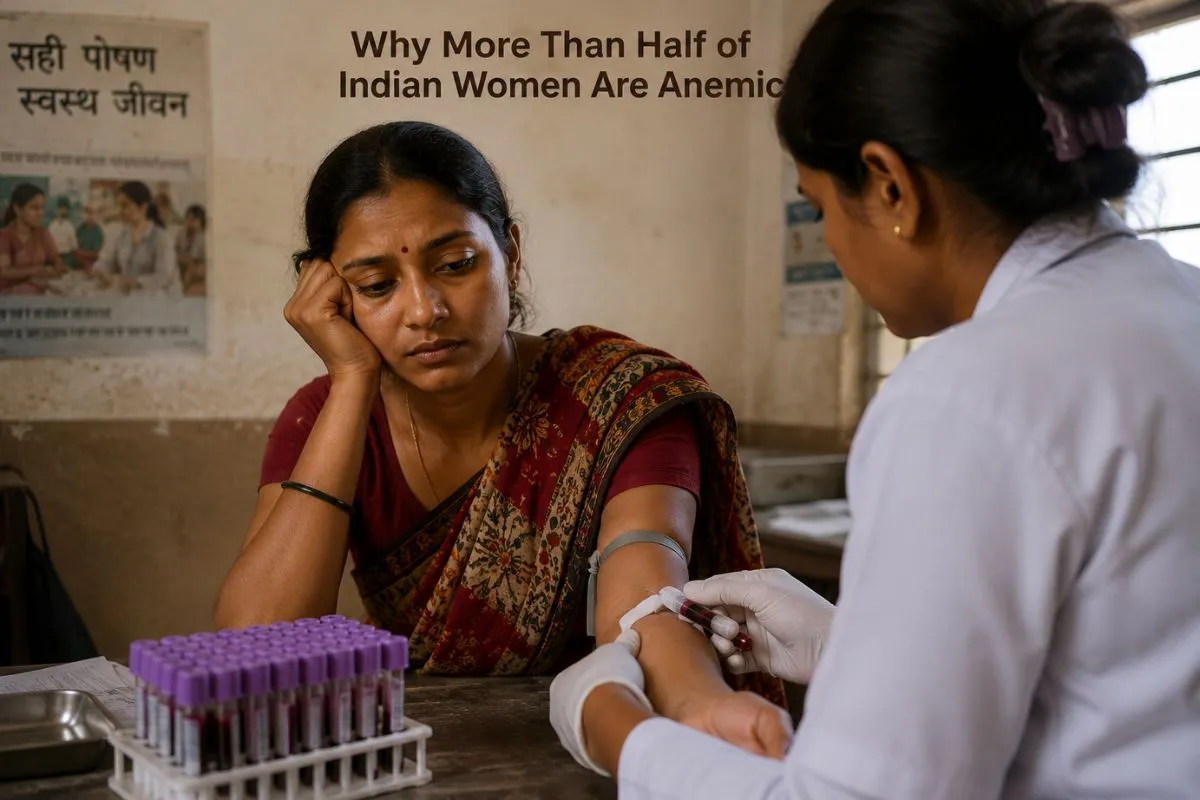
Our Complete Woman’s Guide to Holistic Health touched on how magnesium deficiency quietly undermines sleep, mood, and PMS symptoms, and Your Hormones Are Not the Problem walked through how hormonal shifts across the cycle affect everything from skin to energy. There’s a third deficiency that overlaps with almost every symptom in both of those pieces, fatigue, brain fog, hair thinning, mood changes, and it remains staggeringly common and staggeringly under-discussed: iron deficiency anemia.
The scale of this isn’t a minor statistic. According to India’s National Family Health Survey and multiple peer-reviewed studies, more than half of Indian women of reproductive age are anemic, a figure so high it should arguably be treated as a default health screening question rather than an afterthought.
The Numbers Are Genuinely Staggering
Research analyzing anemia across India consistently finds that iron deficiency affects a majority of women, not a vulnerable minority. One cross-sectional study in Gujarat found that over 55 percent of the pregnant and postnatal women examined were anemic. Global research estimates that iron deficiency accounts for roughly half of all anemia cases in women worldwide, and separate large-scale Indian data has shown low ferritin, the marker of the body’s stored iron, in roughly 34 percent of antenatal and 40 percent of postnatal women studied.
Anemia in India isn’t confined to any one community or region either. A comprehensive analysis tracking anemia prevalence among Indian women from 1998 to 2021 found persistent, widespread rates across a twenty-three year period, driven consistently by inadequate dietary intake, menstrual blood loss, and the heightened iron demands of pregnancy.
It’s Not Always the Anemia You Think It Is
Here’s where the research gets genuinely surprising, and clinically important. Anemia and iron deficiency are not automatically the same thing, and a significant share of anemia in Indian women turns out not to be caused by low iron at all. India’s Comprehensive National Nutrition Survey found that non-iron deficiency anemia, or NIDA, was actually more common than iron deficiency anemia among adolescents studied, at nearly 17 percent compared to 12 percent respectively. A separate cross-sectional study in rural Gujarat reported a similar pattern, non-iron deficiency anemia outpacing the iron-deficient kind among certain groups of women examined.
This matters enormously in practice, because the standard screening method used across India relies almost entirely on haemoglobin levels, not iron status itself. Haemoglobin can be low for reasons that have nothing to do with iron, including deficiencies in vitamin B12 or folate, chronic inflammation, or other underlying conditions. Treating every case of low haemoglobin with iron supplementation alone, without checking ferritin or other iron-status markers, risks missing the actual cause entirely in a meaningful share of cases.
Why Iron Deficiency Hits Indian Women Especially Hard
A few overlapping factors explain why this deficiency is so persistent specifically among Indian women. Diets in many regions lean heavily on plant-based iron sources, which the body absorbs far less efficiently than the iron found in meat and fish. Menstrual blood loss represents a recurring, monthly drain on iron stores that simply doesn’t apply to men, and pregnancy multiplies iron demand substantially, to support both increased maternal blood volume and fetal development. Layer chronic under-screening on top of these biological realities, and the persistence of India’s anemia numbers over more than two decades starts to make sense.
What the Symptoms Actually Look Like
Iron deficiency rarely announces itself clearly, which is part of why it goes undiagnosed for so long. Persistent fatigue that doesn’t improve with rest, pale skin, brittle nails, hair thinning, shortness of breath during ordinary activity, dizziness, and difficulty concentrating are all common signs, and nearly all of them overlap heavily with symptoms people tend to attribute to stress, poor sleep, or simply “being busy.” This overlap is precisely why iron deficiency so often gets missed, or misattributed entirely to something else.
What Actually Works, According to the Research
Oral iron supplementation remains the frontline treatment recommended across Indian clinical guidelines, but a body of recent research has also examined intravenous options for more severe cases. A large real-world study involving nearly 1,200 pregnant Indian women found that intravenous ferric carboxymaltose produced a significant increase in haemoglobin, by 2.8 g/dL on average, along with a substantial rise in ferritin within just four weeks, with even stronger haemoglobin gains observed among women with severe iron deficiency anemia. Ongoing implementation research is now specifically examining single-dose postpartum IV iron treatment across India and Pakistan, aiming to make faster-acting treatment more widely accessible for postpartum women, a group whose iron stores are often severely depleted after childbirth and breastfeeding demands.
For diet-based prevention and mild deficiency, the research is clear on a few practical points. Iron from animal sources, known as heme iron, is absorbed considerably more efficiently by the body than the non-heme iron found in plant sources like lentils, spinach, and fortified grains. Pairing plant-based iron sources with vitamin C, found in citrus fruits, tomatoes, and amla, meaningfully improves absorption, while tea and coffee consumed alongside meals can measurably inhibit iron absorption due to their tannin content, a detail worth knowing given how central chai is to daily life across much of India.
The Bottom Line
Iron deficiency anemia in Indian women isn’t a niche health concern, it’s a majority-prevalence condition hiding behind symptoms that get routinely blamed on everything except their actual cause. The research also makes clear that solving it isn’t as simple as reflexively taking an iron supplement, since a meaningful share of anemia cases in Indian women trace back to causes iron alone won’t fix. If persistent fatigue, hair thinning, or brain fog sound familiar from this list, a proper blood panel checking both haemoglobin and ferritin, not haemoglobin alone, is the genuinely useful next step, not another cup of chai and the assumption that exhaustion is simply part of the schedule.