Guardians of the Vernacular: 3 Indigenous Indian Traditions Rewriting Design
When we look at the evolution of modern architecture, textile design, and contemporary fine art, our textbooks typically point toward the Bauhaus movement of Europe, the minimalism of Scandinavia, or the abstract expressionism of New York.
Yet, tucked away in the geographic folds of the Indian subcontinent, indigenous community collectives have spent centuries perfecting design frameworks that are radically sustainable, structurally genius, and visually arresting. Far from being stagnant relics of the past, these three living traditions are actively showing the global design community how to build, weave, and paint for a resilient future.
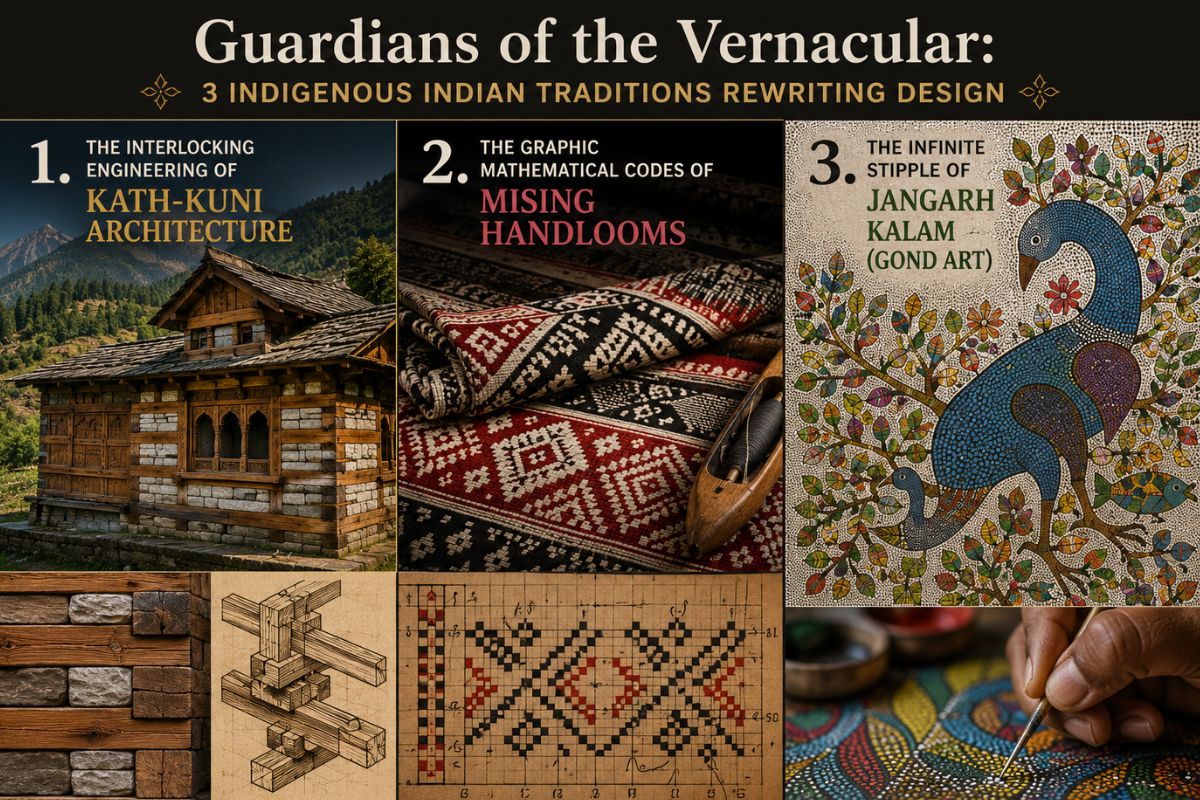
1. The Interlocking Engineering of Kath-Kuni Architecture
In the seismic, snow-heavy ridges of northern Himachal Pradesh—particularly across the Kinnaur and Kullu valleys—stands an ancient, mortarless building tradition known as Kath-Kuni. Derived from the Sanskrit words Kāshth (wood) and Kona (corner), this vernacular architecture has survived centuries of high-intensity Himalayan earthquakes that easily flattened modern concrete structures.
The Structural Genius:
- The Alternating Weave: Walls are constructed by meticulously stacking alternating horizontal courses of locally quarried, un-chiselled stone and heavy beams of endemic Deodar (Himalayan Cedar).
- Zero Mortar, Total Flex: No cement or mortar is used to bind the materials. Instead, the wooden beams are bound together at the corners using intricate, hand-carved tongue-and-groove joints and wooden pegs (kadil).
- Seismic Dampening: When an earthquake strikes, the lack of rigid mortar allows the entire building to flex, slide, and rock slightly. The heavy stone base acts as a stabilizer, absorbing the ground shocks, while the interlocking wooden frame redistributes the energy without fracturing.
2. The Graphic Mathematical Codes of Mising Handlooms
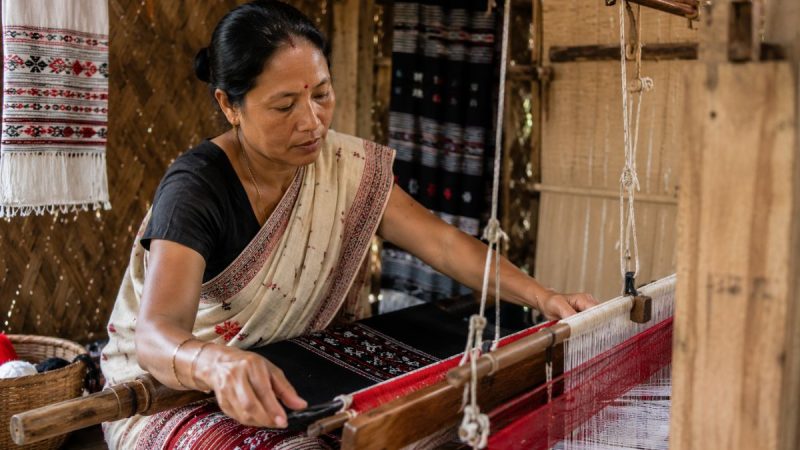
On Majuli and along the floodplains of the Brahmaputra River in Assam, the women of the indigenous Mising community operate a highly sophisticated visual language right from their portable, traditional loin looms and ordinary frame looms.
The Textile Logic:
- The Data Copy (Mimang): Before a Mising weaver passes a shuttle through the warp, she refers to a Mimang—a physical master copy or structural textile blueprint containing complex geometric pattern equations.
- The System of Alam: The foundational pattern of a cloth is governed by a strict graphic matrix called Alam. Using straight, triangular, and converging/diverging lines (Duksub-dugjar), weavers map out complex symmetry with absolute mathematical precision, working entirely from memory.
- Cultural Artifacts: This technique yields stunning garments like the Gale (a structured, striped wrap-around skirt) and the Mirizen, a thick, patterned cotton blanket. Each geometric diamond, star (Takar), and chevron is not merely decorative; it is a coded record of clan identity, river topology, and ancestral migration patterns.
3. The Infinite Stipple of Jangarh Kalam (Gond Art)
The Gond tribe of Central India (primarily Madhya Pradesh) historically adorned the mud walls and floors of their homes with natural pigments to celebrate seasonal cycles and honor Bada Dev (the Great God). However, in the late 20th century, a visionary young artist named Jangarh Singh Shyam transformed this tribal tradition into a global contemporary art movement known as Jangarh Kalam.
The Visual Vocabulary:
- The Signature Grid: While traditional folk art often relies on flat color planes, Jangarh Kalam fills the silhouettes of animals, sacred trees, and animistic spirits with an intricate, dizzying field of repeating dots, fine lines, and short dashes.
- Optical Vibration: Each practicing Gond artist develops their own highly specific, signature stipple or stroke pattern. When these minuscule dots and lines are repeated across a canvas, they create an optical illusion of movement and vibration—making a painted elephant, tiger, or Mahua tree look as if it is actively breathing.
- The Metaphysical Message: This unique stippling technique carries deep philosophical weight. By breaking solid forms down into a field of infinite lines and dots, the art visualizes the core Gond belief that all living beings, trees, and spirits are interconnected and made of the same fluid, cosmic energy.
Traditions Compared
| Tradition | Medium | Core Design Principle | Modern Application |
| Kath-Kuni | Architecture (Stone & Deodar Wood) | Mortarless interlocking joints for high seismic resilience and flexibility. | Green building, eco-resorts, and sustainable earthquake-proof architecture. |
| Mising Handlooms | Textiles (Cotton, Eri & Muga Silk) | Mathematical Alam matrices used to weave dense, complex geometric narratives. | High-end sustainable slow fashion and structural interior textile design. |
| Jangarh Kalam | Fine Art (Canvas, Pigments & Acrylics) | Intricate, signature stippling and line grids that create optical kinetic energy. | Global contemporary fine art, custom wallpaper installations, and book illustrations. |
Design Takeaway: These indigenous systems prove that true innovation is often a matter of preservation. Whether it is a mountain tower standing tall against a seismic tremor or a river-island textile woven with geometric perfection, these practices show us that the most forward-thinking design solutions are already written in our vernacular history.