How Jason deCaires Taylor’s Global Underwater Museums Are Re-Engineering Conservation
For decades, public art galleries operated under a strict, unwritten mandate: control the climate, shield the exhibits from moisture, and plaster them with “Do Not Touch” signs.
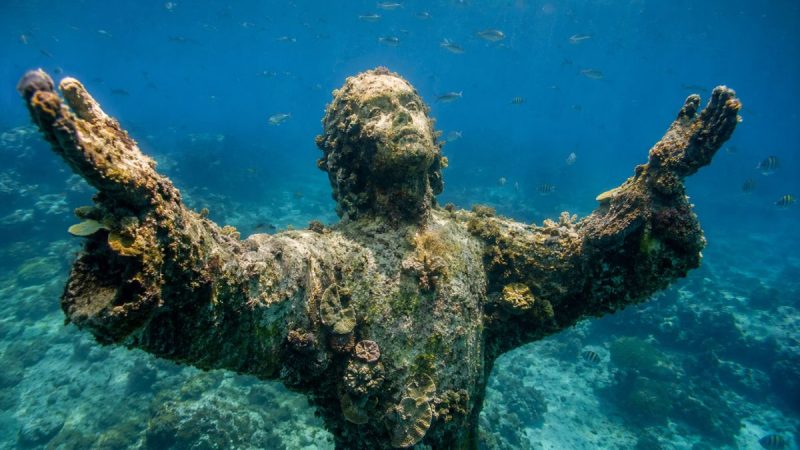
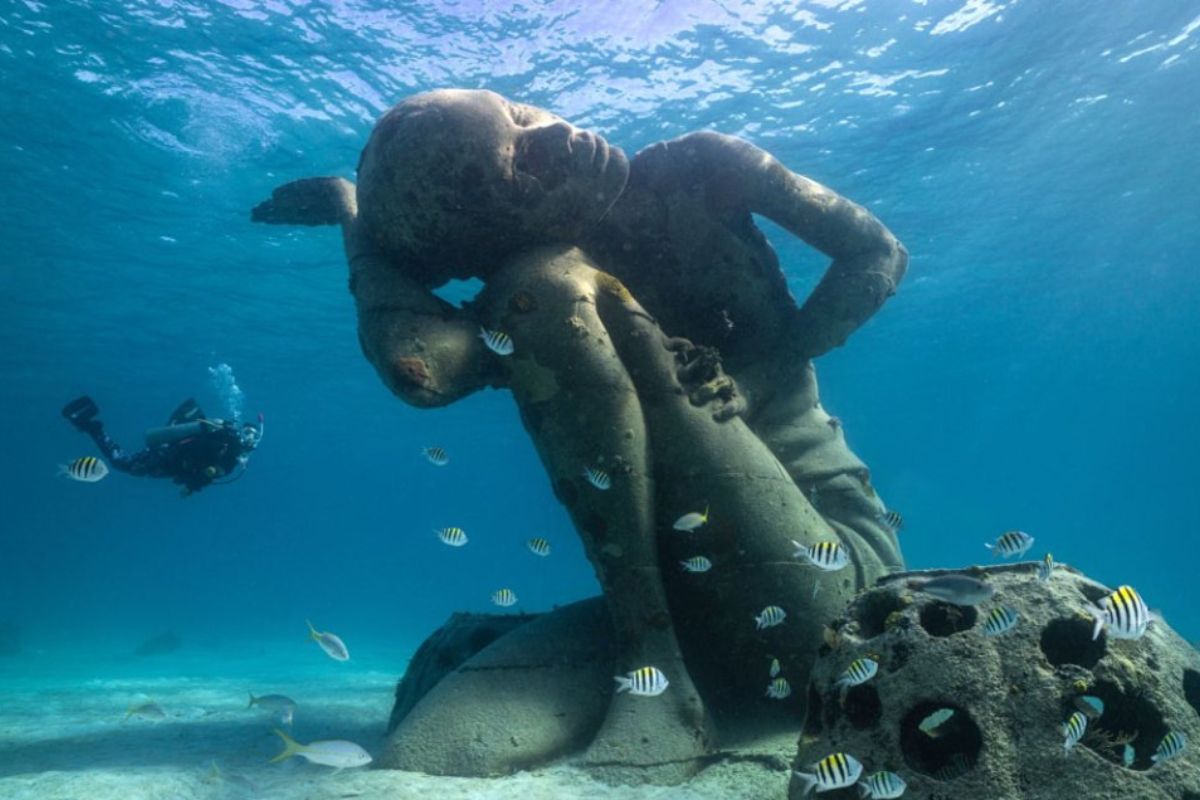
But a quiet revolution is taking place across the ocean floors of the world. Pioneered by world-renowned British sculptor and marine conservationist Jason deCaires Taylor, a new generation of monumental public art is being deliberately submerged into the planet’s oceans. Far from being passive statues, these installations function as massive, bio-enhancing underwater eco-museums.
From the shifting currents of the Caribbean to the delicate coral boundaries of the Great Barrier Reef, these five global sites are transforming the relationship between contemporary sculpture, tourism, and marine engineering.
1. The Genesis: Molinere Bay Underwater Sculpture Park (Grenada, West Indies)
Submerged in 2006, this Caribbean installation was the world’s first public underwater sculpture park and remains a monumental proof-of-concept for artificial reef design.
- The Masterpiece: Vicissitudes—a striking, circular ring of 26 life-sized children holding hands, facing outward into the ocean currents.
- The Ecological Impact: Positioned in a region heavily impacted by Hurricane Ivan, the circle of statues acts as a physical wave-dissipator. By absorbing high-energy surge currents, the installation prevents storm surge erosion along the sandy seabed, allowing delicate native soft corals and sea fans a calm environment to root and thrive.
2. The European Border: Museo Atlántico (Lanzarote, Canary Islands, Spain)
Submerged 12 meters deep within the clear, temperate Atlantic waters of a UNESCO World Biosphere Reserve, this site represents Taylor’s most philosophically complex European work.
- The Masterpiece: Crossing the Rubicon—a dramatic procession of 41 life-sized figures frozen mid-stride as they walk toward a monumental, 30-meter-long, 4-meter-high industrial wall with a single central doorway.
- The Ecological Impact: Cast entirely from inert, pH-neutral marine cement, the giant structural wall has effectively created a major deep-water sanctuary. The massive surface area has become an immediate colonization zone for critical coralline algae, which in turn has attracted massive schools of native angel sharks, butterfly rays, and pelagic sardines back to a previously barren sandy plateau.
3. The Scientific Sanctuary: Museum of Underwater Art / MOUA (Queensland, Australia)
Located at John Brewer Reef off the coast of Townsville, MOUA is the only underwater museum positioned directly in the heart of the Great Barrier Reef Marine Park, functioning as a live, collaborative research station.
- The Masterpiece: The Coral Greenhouse—a biomorphic, open-framed architectural sanctuary weighing over 58 tons, populated by “Ocean Sentinels” (sculptures of world-leading marine scientists and indigenous children fused with local flora).
- The Ecological Impact: Divers can swim directly inside this structural matrix. The stainless-steel and marine-cement framework is specifically engineered with hydro-dynamic gaps that catch floating coral spawn during spawning season, providing them safe shelter from predatory fish and high water temperatures until they fully mature into a self-sustaining reef grid.
4. The Submerged Jungle: MUSAN (Ayia Napa, Cyprus)
Opened in 2021, the Museum of Underwater Sculpture Ayia Napa is a radical departure from human portraiture, manifesting as the world’s first underwater botanical forest.
- The Masterpiece: A dense maze of 93 monumental sculptural trees and towering plant forms, some anchored to the seabed and others suspended mid-water to form a vertical canopy.
- The Ecological Impact: The Mediterranean Sea faces severe fish depletion due to over-tourism and pollution. By introducing a multi-tiered botanical framework at varying depths, MUSAN creates a complex 3D habitat that mimics a natural kelp forest, successfully drawing in juvenile fish, octopuses, and invertebrates that require structural hiding places to escape larger predators.
5. The Shared Canvas: Cannes Underwater Eco-Museum (Cannes, France)
Situated near the historic Île Sainte-Marguerite, this shallow, highly accessible snorkeling site replaced an area of discarded, toxic maritime debris to establish a protected ecological enclave.
- The Masterpiece: Six monumental portrait masks, each over two meters tall, based on real members of the local Cannes community, split down the middle to mirror a theatrical persona.
- The Ecological Impact: Positioned at a shallow depth of just 3 to 4 meters, this museum was explicitly engineered to be accessible without heavy scuba gear. By drawing hundreds of casual snorkelers daily to this designated, boat-free sanctuary, it drastically reduces human crowding and anchor-damage along the highly fragile, neighboring Posidonia seagrass meadows.
The Global Explorer’s Matrix
| Site & Location | Depth | Primary Engineering Focus | Best Suited For |
| Molinere Bay (Grenada) | 5m (16 ft) | Wave dissipation & structural stabilization | Snorkelers & Divers |
| Museo Atlántico (Spain) | 12m (39 ft) | Subsurface reef wall & shark habitat creation | Experienced Divers |
| MOUA (Australia) | 12m (39 ft) | Coral spawn capture & architectural nesting | Certified Scuba Divers |
| MUSAN (Cyprus) | 8-10m (26-33 ft) | Vertical canopy creation for fish nursery | Snorkelers & Divers |
| Cannes Eco-Museum (France) | 3-4m (10 ft) | Seagrass meadow protection & shallow access | Families & Snorkelers |
The Artist’s Philosophy: Jason deCaires Taylor notes that his work is finished only when the cement is completely obscured. The primary objective is to use human art to jumpstart a natural ecosystem, letting the ocean reshape, overgrow, and ultimately reclaim the sculptures until the boundary between human design and the natural world disappears entirely.