
Are We Becoming Emotionally Numb? The Truth Nobody Wants to Admit
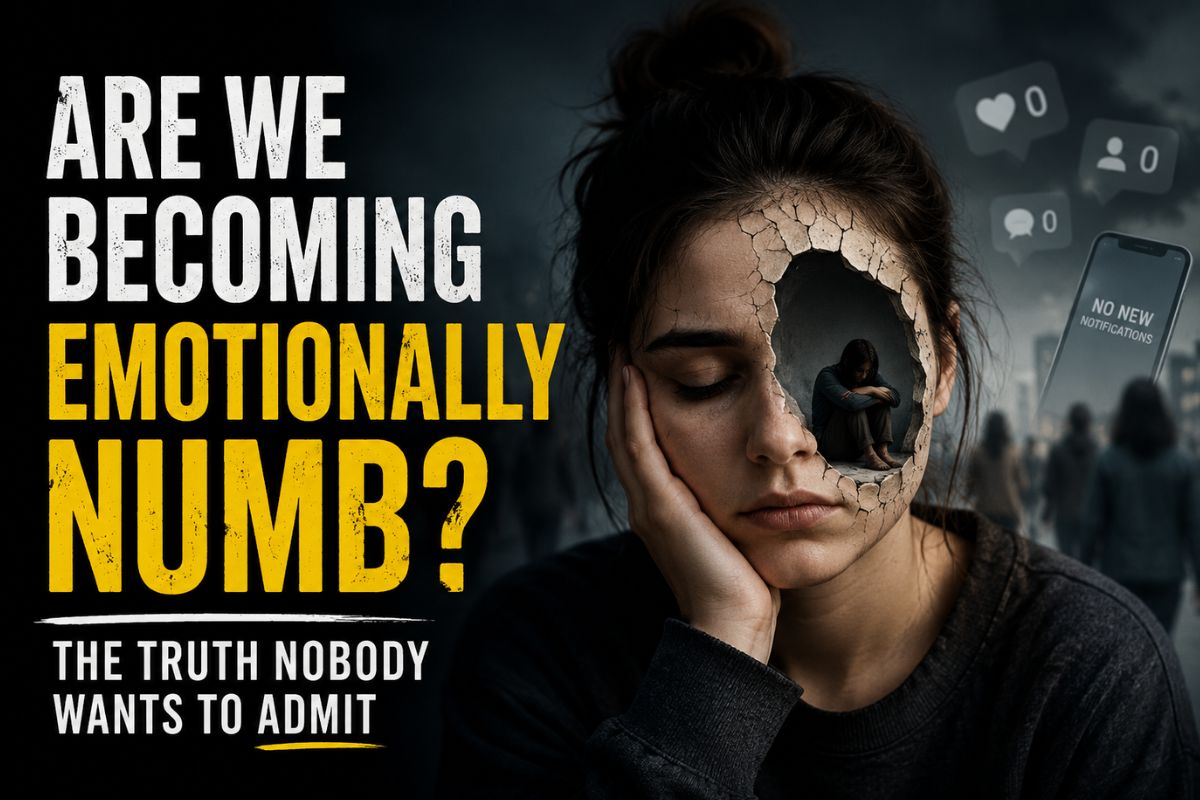
We’re not feeling less because we care less. We’re feeling less because we’ve been asked to carry more than the human mind was ever designed to hold.
There was a time when a single tragedy could stay with an entire nation for weeks.
Today, you scroll past a war.
A natural disaster.
A celebrity death.
A child asking for help.
A wedding.
A funny meme.
A recipe.
A political scandal.
A puppy video.
All in less than five minutes.
You pause.
You react.
You keep scrolling.
Nothing stays long enough to truly touch you.
Nothing hurts long enough to change you.
Nothing inspires you long enough to move you.
Somewhere between endless notifications and infinite scrolling, many people have begun asking a quiet, unsettling question:
“Why don’t I feel things the way I used to?”
You still laugh.
You still cry occasionally.
You still function.
But emotions seem… muted.
You celebrate promotions without excitement.
You receive compliments without believing them.
You lose people without fully grieving.
You watch suffering from around the world and somehow continue eating dinner five minutes later.
It feels wrong.
It feels inhuman.
But perhaps it isn’t.
Perhaps it’s exactly what the brain does when it’s overwhelmed.
Because emotional numbness isn’t always the absence of feeling.
Sometimes, it’s the mind’s last attempt to survive.
📌 The Crux: Emotional Numbness Is Often a Protective Response, Not a Personality Trait
Emotional numbness doesn’t always mean you’ve stopped caring. It can be the brain’s way of protecting itself from chronic stress, emotional overload, burnout, unresolved pain, or constant stimulation.
Feeling “nothing” is often the nervous system saying, “I can’t safely process any more right now.”
The danger begins when protection quietly becomes your permanent way of living.
We Were Never Designed to Feel This Much, This Often
For most of human history, our emotional world was local.
We worried about our family.
Our village.
Our harvest.
Our immediate survival.
Today, before breakfast, you can know about:
A flood in Brazil.
An earthquake in Japan.
A shooting in another country.
Economic uncertainty.
Climate anxiety.
Political conflict.
Thousands of strangers sharing their heartbreak online.
Your brain receives all of it.
Even though you can do almost nothing about most of it.
Psychologists call this emotional overload.
When the volume of emotional information exceeds our ability to process it, the nervous system begins conserving energy.
Not because it doesn’t care.
Because it cannot keep responding at maximum intensity forever.
The Internet Has Changed the Value of Emotion
Every day we witness moments that, decades ago, would have been unforgettable.
Births.
Deaths.
Acts of courage.
Acts of cruelty.
Public confessions.
Private pain.
They’re all compressed into the same endless feed.
This creates a dangerous effect.
Extraordinary events begin to feel ordinary.
When everything is urgent…
Nothing feels urgent.
When everything demands emotion…
Eventually, emotion becomes exhausted.
Not because compassion disappeared.
Because attention has limits.
We’re Constantly Distracting Ourselves From Ourselves
Think about the last time you felt uncomfortable.
How quickly did you reach for your phone?
A moment of boredom.
A difficult conversation.
An awkward silence.
Waiting in a queue.
Lying in bed.
Many of us no longer experience even small moments without filling them.
Music.
Videos.
Podcasts.
Scrolling.
Notifications.
The modern world has become remarkably efficient at helping us avoid ourselves.
The problem is that emotions require quiet.
Grief needs silence.
Reflection needs stillness.
Healing needs space.
Without those things, emotions don’t disappear.
They simply wait.
Burnout Doesn’t Always Feel Like Exhaustion
Most people imagine burnout as dramatic collapse.
In reality, it often arrives quietly.
You stop getting excited.
Nothing surprises you.
Achievements feel strangely empty.
Weekends pass without restoring you.
Vacations become recovery rather than adventure.
You begin saying,
But underneath that tiredness is something deeper.
You have spent so long surviving that your nervous system no longer remembers how to fully engage with joy.
We’ve Started Confusing Productivity With Worth
Modern culture celebrates busyness.
“What have you accomplished?”
“What are you working on?”
“What’s next?”
Rarely do we ask,
“How deeply did you experience today?”
Somewhere along the way, many people stopped living experiences.
They started documenting them.
Optimizing them.
Posting them.
Measuring them.
Life became content.
Instead of fully feeling a sunset, we photograph it.
Instead of celebrating a birthday, we curate it.
Instead of grieving privately, we wonder whether we should post about it.
When every moment becomes performance, authentic emotion quietly fades into the background.
Trauma Doesn’t Always Look Dramatic
Many people assume emotional numbness only follows catastrophic events.
But the nervous system responds to accumulated stress too.
Years of criticism.
Growing up in a home where emotions weren’t welcomed.
Being expected to stay strong all the time.
Repeated disappointment.
Financial pressure.
Caregiving without rest.
Emotional neglect.
None of these experiences may seem dramatic in isolation.
Together, they can teach the brain that feeling deeply is unsafe.
So it adapts.
Not by becoming heartless.
By becoming protective.
Why Joy Often Disappears First
This surprises many people.
They expect numbness to affect sadness.
Often, joy disappears first.
The same emotional system that processes pain also processes pleasure.
When the brain reduces emotional intensity to protect you from suffering, it can also reduce your ability to experience delight.
You don’t just stop hurting.
You stop fully enjoying.
The music sounds flatter.
The food tastes ordinary.
The laughter feels distant.
Life loses color.
Not because joy vanished.
Because your emotional volume has been turned down.
Social Media Rewards Reaction, Not Reflection
Online platforms are built to capture attention.
The faster you react, the longer you stay.
Outrage spreads quickly.
Shock spreads quickly.
Fear spreads quickly.
Reflection doesn’t.
Understanding takes time.
Empathy takes patience.
Healing requires slowness.
The digital world rarely rewards those qualities.
As a result, many people experience hundreds of emotional triggers every day without ever processing a single one.
Eventually, the mind adapts by feeling less.
Emotional Numbness Can Hide Behind High Functioning
One of the biggest myths is that emotionally numb people can’t function.
Many do.
They go to work.
Pay bills.
Attend family gatherings.
Smile in photographs.
Meet deadlines.
Laugh at jokes.
From the outside, everything appears normal.
Inside, life feels strangely distant.
They aren’t living badly.
They’re living disconnected.
That’s why emotional numbness often goes unnoticed, even by the person experiencing it.
The Cost of Never Feeling
At first, numbness feels like relief.
Nothing hurts as much.
Conflict becomes easier to tolerate.
Loss becomes easier to survive.
But over time, the cost becomes clear.
You stop falling in love with life.
You become indifferent to beauty.
Relationships become routine.
Dreams lose urgency.
Success feels strangely empty.
Protection quietly becomes imprisonment.
A heart that never breaks is also a heart that never fully opens.
Can You Feel Again?
Yes.
But not by forcing emotions.
You cannot command yourself to feel deeply.
You create conditions where emotions feel safe to return.
That begins with slowing down.
Turning off constant noise.
Sleeping enough.
Spending time in nature.
Having honest conversations.
Writing down thoughts instead of scrolling away from them.
Allowing yourself to cry without apologizing.
Seeking professional support when emotional numbness is persistent, distressing, or connected to trauma, anxiety, or depression.
Emotions return through permission, not pressure.
Five Gentle Ways to Reconnect With Your Emotions
1. Sit With Silence
Spend ten minutes each day without music, videos, or notifications.
Discomfort is often the doorway back to awareness.
2. Name What You’re Feeling
Instead of saying, “I’m fine,” try asking yourself:
Am I disappointed?
Anxious?
Lonely?
Overwhelmed?
Relieved?
Giving emotions a name often reduces their intensity and increases your understanding of them.
3. Consume Less, Experience More
Read fewer opinions.
Watch fewer clips.
Take more walks.
Cook a meal slowly.
Listen to a friend without multitasking.
Presence rebuilds emotional connection.
4. Let Yourself Grieve Small Things
Not every loss involves death.
Friendships end.
Dreams change.
Children grow up.
Jobs evolve.
Homes are left behind.
Acknowledging these losses prevents emotions from becoming buried.
5. Ask for Help Without Waiting to Break
You don’t need a crisis to deserve support.
Talking with someone you trust or with a qualified mental health professional can help you reconnect with emotions that have felt distant for a long time.
The Truth Nobody Wants to Admit
Perhaps we are becoming emotionally numb.
But not because humanity is becoming colder.
Because modern life rarely allows us to fully process what we experience.
We have normalized constant stimulation.
Constant urgency.
Constant comparison.
Constant performance.
The human heart was never designed for constant.
It was designed for rhythm.
For rest.
For connection.
For recovery.
For moments that are fully lived instead of endlessly consumed.
Final Thought
If you’ve been wondering why life feels flatter than it once did…
Why joy doesn’t arrive as easily…
Why grief seems delayed…
Why excitement fades quickly…
Don’t immediately assume you’ve become uncaring.
You may simply be emotionally exhausted.
And exhaustion is not the end of feeling.
It’s often the nervous system asking for something we’ve forgotten how to give ourselves.
Space.
Silence.
Time.
Because the opposite of emotional numbness isn’t constant happiness.
It’s the courage to feel life as it is, beautiful, painful, uncertain, and deeply human.
Reading List: More on RealShePower
- She Feels Everything: A Woman’s Complete Guide To Mental Health & Emotional Resilience — A full framework for recognizing when coping has quietly turned into shutting down.
- You Are Not Burned Out Because You’re Weak. You’ve Been Carrying Too Much For Too Long. — How chronic overload flattens emotion long before it looks like exhaustion.
- How Women Become Experts At Suffering, And Why It Must End With Us — On the conditioning that teaches women to disconnect from their own feelings early.
- Your Mirror Is Not A Courtroom — What it looks like when self-criticism becomes so constant it stops registering as pain at all.
- Stop Auditioning For Love. You Were Never Meant To Earn A Place That Was Already Yours. — Why performing okay-ness for others can quietly numb what’s actually happening underneath.