Top 10 Bhakti Stories From Hinduism That Still Give Goosebumps

Some stories don’t need embellishment to move people, they’ve survived for thousands of years purely on the strength of what they represent: love for the divine so absolute that it bends the rules of logic, caste, danger, and even death itself. Here are ten of the most powerful devotion stories from Hindu tradition, and why they still land as hard today as they did centuries ago.
- Prahlada survived every attack from his own father because his devotion never wavered
- Dhruva’s childhood penance won him a permanent place as the pole star
- Shabari’s tasted berries proved love matters more than ritual purity
- Eklavya sacrificed his thumb as guru dakshina after training in secret
- Meerabai survived poison sent by her own family, singing to Krishna
- Kannappa gave both his eyes to a bleeding Shiva Linga without hesitation
- Nandanar walked through fire after caste barred him from a temple for years
- Gajendra was freed only after abandoning his own strength and truly surrendering
- Ajamila was saved by accidentally calling his son’s name, “Narayana”
- Draupadi’s saree became endless the moment she called out to Krishna completely
1. Prahlada, the Boy Who Would Not Stop Chanting
Born to the tyrant king Hiranyakashipu, who had declared himself immune to death and demanded to be worshipped as god, Prahlada refused to renounce his devotion to Vishnu even as a child. His father tried poison, wild elephants, cliffs, and fire, and each time Prahlada emerged unharmed, protected by his unwavering faith. It ended with Vishnu tearing through a palace pillar as Narasimha, half-man half-lion, to destroy Hiranyakashipu at twilight, on a threshold, on his lap, using claws rather than any weapon, satisfying every impossible condition of the tyrant’s boon.
Why it matters:Prahlada’s story is often cited as proof that devotion cannot be beaten out of a person by fear or punishment.
2. Dhruva, the Child Who Became a Star
A five-year-old prince, humiliated by his stepmother for wanting to sit on his father’s lap, walked into the forest alone determined to find a seat no one could ever take from him again. His penance was so intense that Vishnu himself appeared before him. Dhruva was granted a place in the sky as Dhruva Tara, the pole star, fixed and unmoving while every other star appears to circle around it.
Why it matters:It remains one of mythology’s most quoted illustrations of how focused devotion, even from a child, can outlast a lifetime of adult ambition.
3. Shabari and the Tasted Berries
An elderly forest-dwelling devotee, Shabari waited years at her hermitage on the mere hope that Rama would one day pass her way. When he finally did, she offered him wild berries, tasting each one first to make sure it was sweet enough for her Lord, discarding any that weren’t, technically making the offering impure by ritual standards. Rama ate them anyway, and is said to have called them the best meal he had ever received.
Why it matters:It’s one of the clearest scriptural rejections of ritual purity as a precondition for devotion, love mattered more than protocol.
4. Eklavya’s Guru Dakshina
Denied training by Dronacharya for being of a background the guru would not formally teach, Eklavya built a clay image of Dronacharya in the forest and practiced archery before it daily, until he outclassed even Dronacharya’s most gifted royal student, Arjuna. When Dronacharya realised this and demanded Eklavya’s right thumb as guru dakshina to protect Arjuna’s status, Eklavya cut it off without hesitation, crippling his own archery forever.
Why it matters:It is often read less as a story of a fair guru and more as a story of how far unconditional devotion can be exploited, a tension that has kept it relevant in modern retellings.
5. Meerabai’s Poison
Rajput princess Meerabai’s devotion to Krishna was so consuming that she reportedly ignored her royal duties, and legend holds that her disapproving in-laws sent her a cup of poison disguised as prasad. She is said to have drunk it while singing to Krishna, believing it to be nectar, and survived completely unharmed.
Why it matters:Her life became a template for bhakti poets after her, proof that devotion could override even a woman’s expected obedience to family and royal expectation.
6. Kannappa’s Ultimate Offering
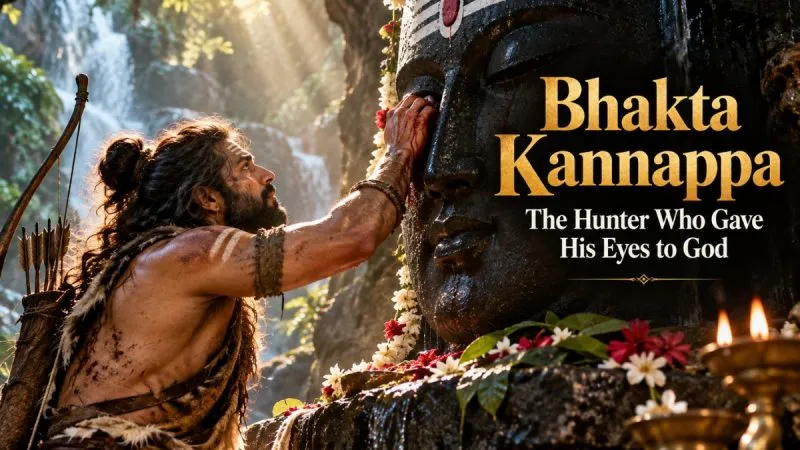
A tribal hunter named Thinnan discovered a forgotten Shiva Linga deep in a forest and began worshipping it his own way, with meat, water carried in his mouth, and flowers from his own hair. When the Linga’s eyes appeared to bleed, he tore out his own eyes, one after another, to stop it, without a moment’s hesitation.
Why it matters:Shiva accepted his rough, ritually “incorrect” worship as purer than a trained priest’s formal rites.Read the full story of Kannappa here.
7. Nandanar’s Walk Through Fire
Born into a community denied entry into temples, farm labourer Nandanar spent years circling the walls of the Chidambaram temple, weeping, never once turning his exclusion into bitterness. When Shiva finally intervened in the priests’ dreams, Nandanar walked through consecrated fire unharmed to reach the sanctum.
Why it matters:It remains one of Bhakti tradition’s sharpest rebukes of caste-based exclusion from the divine.Read the full story of Nandanar here.
8. Gajendra Moksha, the Elephant’s Final Cry
An elephant king, Gajendra, was seized by the leg by a crocodile while bathing in a lake and fought for what mythology describes as a thousand years without release. Only when he abandoned his own strength entirely and cried out to Vishnu with a single flower held up in surrender did Vishnu appear instantly, arriving faster than any of the gods Gajendra had called on before, and freed him.
Why it matters:It is frequently cited as the definitive story of surrender, the idea that devotion works best not as another form of effort, but as the moment effort finally runs out.
9. Ajamila’s Deathbed Redemption
Ajamila lived a life scripture describes as deeply sinful, but as Yama’s messengers came to claim him at death, he cried out for his son, whose name happened to be Narayana, one of Vishnu’s names. Vishnu’s own messengers intervened immediately, arguing that even an accidental utterance of the divine name carried enough weight to override a lifetime of misdeeds.
Why it matters:It’s one of the most cited stories in Bhakti philosophy for the idea that sincerity, even by accident, outweighs a lifetime’s record.
10. Draupadi’s Endless Cloth
During her attempted disrobing in the Kaurava court, Draupadi is said to have first tried to save herself through logic and appeals to the assembly’s honour, and only called out to Krishna wholeheartedly when every rational option had failed. Krishna is said to have answered by making her saree endless, so that no matter how much cloth was pulled away, it never ran out.
Why it matters:It’s remembered as proof that Krishna’s promise to his devotees was never conditional on them asking correctly, or asking early, only on asking at all.
Suggested Reading
- Kannappa: The Devotee Who Plucked Out His Own Eyes for Shiva
- Nandanar: The Untouchable Saint Who Walked Through Fire
- 10 Timeless Takeaways from the Ashtavakra Gita
- The Many Magics of Neem Karoli Baba: A Life of Love, Service and Silent Wonder
- Symbolism of the Midnight Birth: The Spiritual Meaning Behind Krishna’s Birth