Nandanar: The Untouchable Saint Who Walked Through Fire
- Nandanar was a Paraiyar farm labourer and devoted Shiva bhakta, nicknamed “the one who will go tomorrow”
- His prayers are said to have moved a stone Nandi bull at Thirupungur so he could see the deity
- A hostile landlord’s impossible harvest condition was fulfilled overnight through divine help
- Barred from Chidambaram temple for his caste, he waited outside for days without bitterness
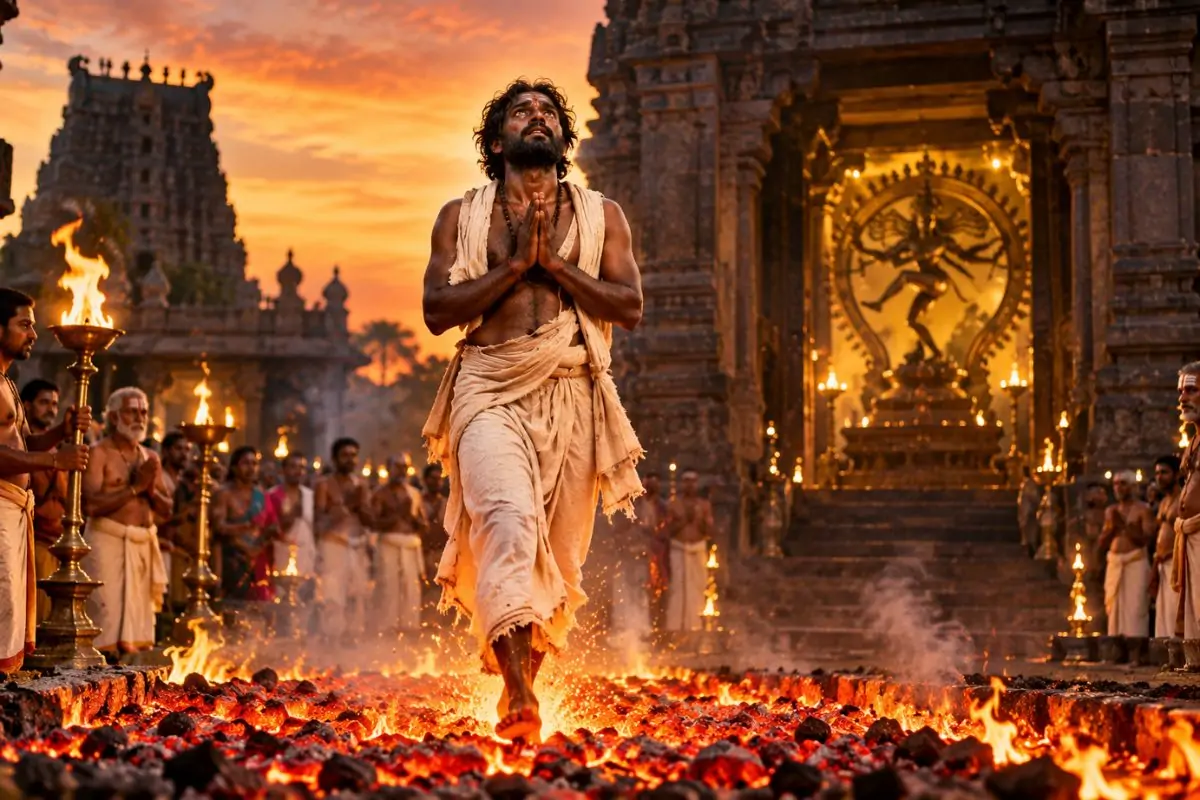
- Shiva instructed the priests to let him in; Nandanar walked through fire unharmed to prove his devotion
- He is one of the 63 Nayanars, and later became a powerful symbol in Dalit rights movements
There is a story kept alive across centuries of Tamil devotion, one that Dalit rights movements have since claimed as their own, that Bharatanatyam dancers have performed as sacred theatre, and that temple priests at Chidambaram still retell with a kind of hushed awe. It is the story of Nandanar, a farm labourer born into the community that built the parai drum, who was denied entry into a Shiva temple his entire life, and who ultimately walked through fire to reach the god he loved.
He is counted among the 63 Nayanars, the canonised Shaiva saints of the Bhakti tradition, and his tale sits differently from most of theirs. It isn’t a story of a king, a poet, or a warrior. It is the story of a man the world refused to see as worthy, and whom Shiva refused to leave behind.
Born Nandanar, Called “Tomorrow”
Nandanar was born in the fertile village of Adhanur on the banks of the river Kollidam, into the Paraiyar community, a community historically associated with making the parai drum, and one that colonial-era society would later push to the very margins of the caste order. From childhood, his heart belonged entirely to Shiva.
He worked as a farm labourer for a Brahmin landlord, and every single day, he told his friends the same thing when they asked if he would finally travel to see the Lord at Chidambaram: “Naalai poven,” I will go tomorrow. He said it so often, and postponed so consistently out of a sense of his own unworthiness, that the village stopped believing him. In time, this became his name. He was called Tirunalaipovar, “the one who will go tomorrow,” a title that quietly captures a lifetime spent yearning for a god he did not yet feel permitted to approach.
The Moving Stone Bull
Before Chidambaram, there was Thirupungur. Nandanar journeyed there hoping simply to glimpse the Shiva Linga inside the temple, only to find his view completely blocked by a massive stone statue of Nandi, Shiva’s bull, positioned directly in front of the sanctum. He stood outside, unable to enter, and began to sing his longing to the Lord with such intensity that something extraordinary happened.
At the temple in Sivalokanathar, Thirupungur, his prayers are said to have moved a giant stone bull, and the statue is said to still stand in that shifted position to this day. It was the first sign that this labourer’s devotion carried weight that stone itself could not resist.
The Landlord’s Impossible Condition
Word of his growing devotion did not soften the world around him. When Nandanar finally worked up the courage to ask his landlord for leave to travel to Chidambaram for Arudra Darshana, one of the holiest days associated with Nataraja, he was met with contempt. The landlord refused outright, and set what he assumed was an impossible condition: he would only be allowed to go if he first harvested two hundred and fifty acres of land, alone, in three days.
Nandanar spent the night in tears, praying, certain the task was beyond any human being. By morning, the entire field had been harvested. The landlord, shaken, later revealed that he had dreamed of Shiva and his ganas working the land themselves through the night. Humbled, he released Nandanar with money for the journey and sent him on his way.
Turned Away at the Gates of God
If the story ended there, it would already be remarkable. But its most piercing moment was still ahead. When Nandanar finally reached Chidambaram, exhausted and overjoyed, he was stopped before he could even approach the sanctum. As an “untouchable” in the eyes of the temple’s caste order, he was not permitted inside.
He circled the temple walls for days, weeping, singing, refusing to leave, yet never once turning his devotion into resentment. According to the oldest surviving verses about him, three thousand Brahmin priests of Chidambaram are said to have eventually saluted him, a detail preserved in Tamil devotional literature as an early sign that his devotion had already begun to outweigh the barrier placed in front of it.
The Fire That Did Not Burn
The resolution came not from Nandanar defying the temple, but from Shiva intervening directly. Nataraja is said to have appeared in the dreams of the temple priests, instructing them to bring Nandanar inside. Uncertain how to reconcile this divine command with the caste restrictions of the time, the priests devised a test rooted in the ancient practice of trial by fire: they asked Nandanar to walk through flames, saying that if his devotion was as pure as it seemed, the fire would not touch him.
Nandanar didn’t hesitate. He is said to have ritually purified himself by fire at Thillai Nataraja Temple, Chidambaram, walking through it unharmed, and was then led into the sanctum sanctorum itself, where he beheld Nataraja face to face and merged into the Lord’s presence, attaining liberation.
A Saint Reclaimed Across Centuries
Nandanar’s story did not stay static. The earliest references, by the poet Sundarar in the 8th century, mention only “Tirunalaipovar” in passing, and it was the 12th-century Periya Puranam that first gave his life a full telling, though largely one that emphasised his acceptance of caste boundaries rather than his suffering under them. It was the 19th-century Tamil poet Gopalakrishna Bharati, through his opera Nandanar Charitram, who reshaped the story for a wider public, and later Dalit retellings would go further still, foregrounding his exploitation and asserting his religious superiority over the very priests who had once barred his way. In the 20th century, Nandanar was embraced as an icon within Dalit rights movements, a devotional figure whose suffering and eventual triumph carried unmistakable social meaning.
Today, shrines to Nandanar stand at both Thirupungur and Chidambaram, the two sites of his miracles, and his story continues to be staged in Bharatanatyam and Tamil musical theatre, sung with the same longing that once kept a farm labourer circling a temple wall he was told he could never enter.