The Golden Goddess of Stambhana: A Devotional Exploration of Maa Baglamukhi
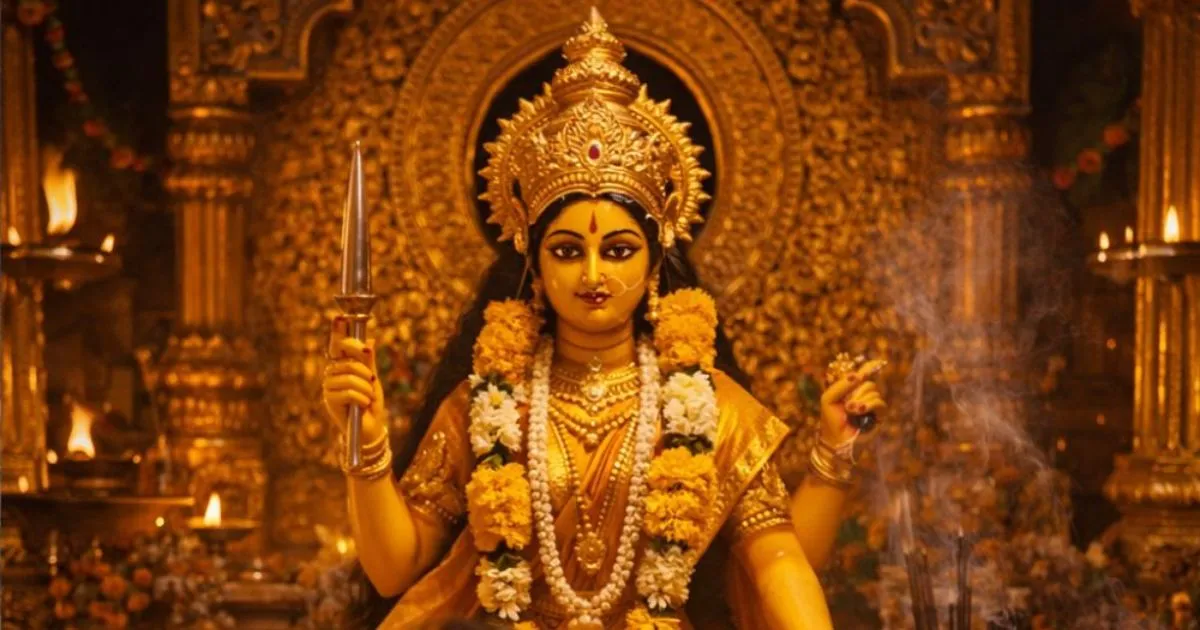
In the celestial pantheon of the Das Mahavidyas (the ten Great Wisdom Goddesses), there exists a form of the Divine Mother so potent, so striking, and so uniquely powerful that her very name commands silence. She is Maa Baglamukhi, the eighth Mahavidya, the goddess who paralyses the speech and movement of enemies, and the supreme embodiment of the power of Stambhana (immobilization).
To the devotee, she is not merely a deity of conflict, but the “Pitambara Devi” the one who is draped in yellow, the color of prosperity, intellect, and spiritual victory.
The Origin and Mythology: The Appearance of the Yellow Goddess
The story of Maa Baglamukhi’s manifestation is a testament to her role as the ultimate protector of the cosmic order. According to the Swatantra Tantra, during the Satyuga, a massive storm threatened to destroy the entire creation. The winds were so fierce and the chaos so absolute that even the gods feared the dissolution of the universe.
In their desperation, Lord Vishnu performed intense penance at the bank of the Haridra Sarovar (the Lake of Turmeric). Pleased by his devotion, a great radiance emerged from the lake—a golden light that crystallized into the form of Maa Baglamukhi. With a single glance, she paralyzed the storm, freezing the chaos in its tracks and restoring peace to the three worlds.
“She is the power that stops the wind, the thought, and the speech of the unrighteous.”
Iconography and Symbolism: The Language of Gold
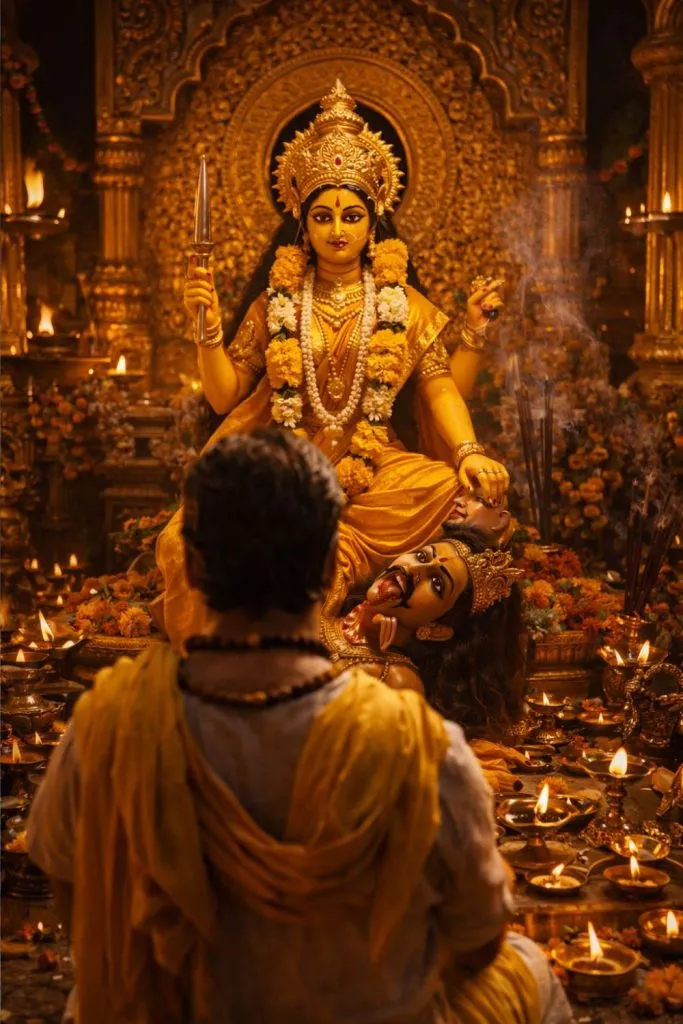
When we meditate upon the form of Maa Baglamukhi, we see a vision of radiant yellow. This is not accidental; every aspect of her appearance is a profound symbol of spiritual truth.
- The Color Yellow (Pitambara): She is adorned in yellow garments, wears yellow flowers, and sits upon a yellow throne. Yellow represents the Muladhara Chakra, the earth element, and the stability of the intellect. It symbolizes the ripening of wisdom and the neutralizing of negativity.
- The Crane (Bagla): The name Bagla is a corruption of Valga, meaning “bridle” or “bit.” Just as a bridle controls a horse, the Goddess controls the erratic movements of the mind and the tongues of detractors. However, she is also associated with the Crane (Bak), a bird known for its intense focus and stillness before it strikes its prey—symbolizing the power of concentration.
- The Act of Pulling the Tongue: In her most famous depiction, she is seen holding a club in one hand and pulling the tongue of a demon (asura) with the other. This represents the silencing of gossip, lies, and the internal “chatter” of the ego that prevents us from realizing the Truth.
The Science of Stambhana: More Than Just “Paralyzing”
In Tantric philosophy, the power of Maa Baglamukhi is categorized as Stambhana. While the worldly interpretation of this is the “paralyzing of enemies,” the spiritual depth goes much further.
- Stambhana of the Mind: Our greatest enemy is the restless mind. Maa Baglamukhi helps the practitioner reach a state of Samadhi by “freezing” the constant flow of distracting thoughts.
- Stambhana of Speech: She grants the devotee the power of Vaak Siddhi. When the Mother silences the useless speech of the ego, what remains is the truth. Her devotees often find that their words carry weight and that they are protected from slander.
- Stambhana of Evil Forces: Whether it is a legal battle, a professional rivalry, or internal demons like lust and anger, she acts as a shield, rendering the opposition ineffective.
The Rituals and Worship (Sadhana)
Worshiping Maa Baglamukhi is a path of discipline. Unlike the gentler forms of the Mother, Baglamukhi Sadhana is precise and demands absolute purity of intent.
The Essentials of Worship
- Yellow Everything: The devotee wears yellow clothes, uses a yellow asana (mat), and offers yellow flowers (marigolds or yellow oleander).
- The Rosary (Mala): Chanting is traditionally done using a Haldi Mala (rosary made of dried turmeric roots).
- The Offering: Yellow sweets, such as besan laddoo or rice cooked with turmeric and saffron, are offered as Prasad.
The Beeja Mantra
The heartbeat of her worship is her Beeja (seed) mantra. It is said that the vibration of this mantra can alter the energetic field around the practitioner.
The full Baglamukhi Mool Mantra is a powerful invocation:
“Om Hlreem Baglamukhi Sarwadustanaam Vaacham Mukham Padam Stambhay Jihwaam Keelay Budhim Vinashaay Hlreem Om Swaha”
Translation: “O Goddess, paralyze the speech and feet of all evil people. Pull their tongue, destroy their intellect so that they cannot harm me.”
The Spiritual Significance of the “Enemy”
Devotion to Maa Baglamukhi requires a shift in perspective. Who is the “enemy” we are asking her to silence?
While she certainly protects her children from external harm, the advanced devotee realizes that the “evil ones” mentioned in the mantra are also internal. The Sarwadustanaam (all evil ones) refers to the Arishadvargas:
- Kama (Lust)
- Krodha (Anger)
- Lobha (Greed)
- Moha (Attachment)
- Mada (Pride)
- Matsarya (Jealousy)
When Maa Baglamukhi “pulls the tongue” of these internal enemies, the soul is finally free to experience its own divinity. She is the goddess of the Middle Path, the stillness that exists between the inhalation and the exhalation.
Famous Pilgrimage: Datia and Kangra
For those seeking her physical presence, two temples stand as the primary pillars of her energy in India:
- Pitambara Peeth, Datia (Madhya Pradesh): Established by Swami Ji Maharaj, this is perhaps the most powerful center for Baglamukhi Sadhana. It is a place of immense stillness where the air feels thick with her golden vibration.
- Baglamukhi Temple, Bankhandi (Himachal Pradesh): Nestled in the Kangra valley, this ancient temple is said to date back to the Mahabharata era. It is believed that the Pandavas worshiped her here to ensure victory in the Great War.
A Devotional Reflection: The Mother’s Protection
To love Maa Baglamukhi is to feel a sense of absolute fearlessness. In a world that is often loud, chaotic, and critical, she is the Great Silence. She teaches us that sometimes, the most powerful response is no response at all. By paralyzing the negativity around us, she gives us the space to grow.
She is the Mother who stands at the threshold. When the world tries to overwhelm you, she raises her club—not to destroy, but to halt the tide. When the mind tries to lie to you, she holds the tongue.
Why should a devotee fear?
The one who has surrendered to the Golden Mother finds that their enemies become like statues, their obstacles become like mist, and their path becomes as bright as a field of sunflowers under the midday sun.
Conclusion: Invoking the Golden Grace
Maa Baglamukhi is the goddess of the “unspoken.” She reminds us that the Ultimate Reality is beyond words, and only by silencing the false can we hear the True. Whether you are facing legal troubles, personal strife, or the internal war of the spirit, her yellow light is a beacon of hope.
As we bow to the Pitambara Devi, we pray not just for the defeat of others, but for the victory of the Self. May she paralyze our doubts, still our anxieties, and lead us into the golden radiance of eternal peace.
“Om Hlreem Baglamukhyai Namah”
Related Read
A fierce yet profound symbol of transformation, ego-detachment, and spiritual awakening through self-sacrifice.
Click to Read More →