
Sathankulam Custodial Death Verdict 2026: Death Penalty for 9 Police Officers
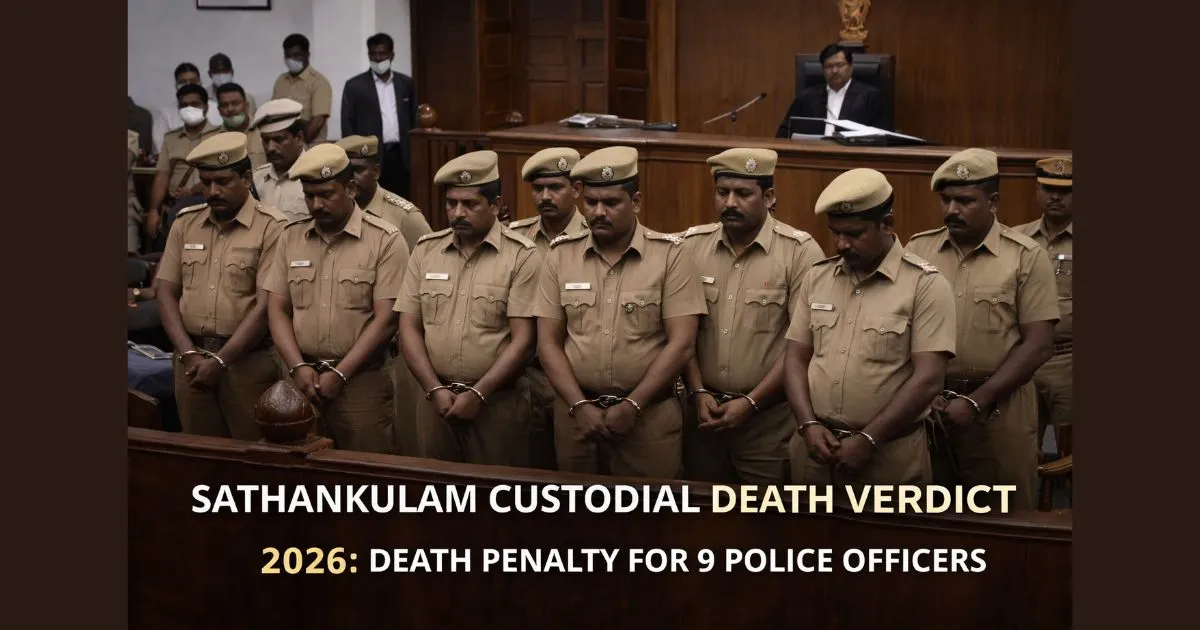
Sathankulam Custodial Death Verdict 2026
This landmark judgment, delivered on April 15, 2026, marks one of the few instances in Indian judicial history where an entire group of police officers has been sentenced to death for custodial torture. The verdict effectively closes a six-year legal battle that became a national symbol for police reform.
The 2026 Verdict: A Breakdown
Judge G. Muthukumaran of the Madurai Sessions Court delivered a 400-page judgment, emphasizing that the “protectors of the law cannot be allowed to become its predators.“
| Key Detail | Information |
| Convicts | Former Inspector S. Sridhar, Sub-inspectors Balakrishnan and Raghuganesh, and six others. |
| Charges | IPC Sections 302 (Murder), 201 (Destruction of evidence), and 342 (Wrongful confinement). |
| Evidence | Over 100 witnesses and critical forensic data from the Sathankulam station floor. |
| Status | The death sentences must be confirmed by the Madras High Court before execution. |
The Fatal Timeline (June 2020)
To understand the severity of the 2026 sentencing, one must look at the specific findings of the CBI investigation regarding the 72 hours that led to the deaths of P. Jayaraj and J. Bennix.
- The Arrest
June 19, 2020
Jayaraj is picked up for allegedly violating COVID-19 lockdown hours at his mobile shop. His son, Bennix, follows him to the station to inquire and is also detained.
- Overnight Torture
June 19–20, 2020
CBI evidence proved the duo was subjected to severe physical assault involving lathis. Witness statements from female police personnel confirmed the screams were heard outside the station.
- Hospitalization & Death
June 22–23, 2020
Bennix dies at the Kovilpatti General Hospital on the night of the 22nd; his father, Jayaraj, passes away the following morning. Both deaths were attributed to internal hemorrhaging and blunt force trauma.
Why it Qualified as “Rarest of Rare”
The Indian judiciary typically reserves the death penalty for crimes that “shock the collective conscience.” The court highlighted three factors that elevated this case to that threshold:
- Systemic Betrayal: The court noted that the victims were in the “absolute custody” of the state. When the state’s enforcement arm commits murder, it is viewed as an attack on the Constitution itself.
- Destruction of Evidence: The CBI proved that the station’s CCTV footage was “accidentally” deleted and bloodstains were wiped clean by the officers involved—demonstrating a calculated attempt to bypass the law.
- The “Laundered” FIR: The original First Information Report filed by the Sathankulam police claimed the father and son had “rolled on the ground” to cause their own injuries—a claim the court dismissed as a fabrication to hide the brutality of the assault.
“The brutality displayed was not an act of negligence but a cold-blooded exercise of power.” — Judge G. Muthukumaran, April 2026
Legal Precedent & Next Steps
Under Section 366 of the Code of Criminal Procedure, the execution is stayed automatically until the Madras High Court reviews the case. The defense is expected to appeal, likely arguing for a commutation to life imprisonment by citing the convicts’ years of service prior to the incident. However, legal experts suggest the “custodial” nature of the crime makes a sentence reduction difficult.