Bail Is the Rule, Unless You Cannot Afford a Lawyer
On July 3, 2026, a bench of the Supreme Court of India sat through a hearing on whether Sonam Raghuvanshi, accused of orchestrating her husband’s murder during their honeymoon, should remain out on bail. The justices noted, correctly, that “bail is the rule and jail is exception,” a principle that has anchored Indian criminal law for decades. They stayed the High Court’s bail order, expressed reservations about how it had been granted in the first place, and scheduled the next hearing for the following week. Her case has, by this point, produced a Meghalaya High Court ruling, a Supreme Court appeal, live coverage of each development, and arguments from a Solicitor General about a disputed legal provision.
That same week, somewhere in an Indian jail, a woman with no name recognition, no film deal, and no lawyer capable of arguing a procedural technicality all the way to the Supreme Court was almost certainly still waiting. Waiting for a bail hearing nobody had scheduled. Waiting for a legal aid lawyer who might see her file for the first time on the morning of a hearing she did not know was happening. Waiting, in a meaningful number of cases, for a trial to conclude on a sentence shorter than the time she has already spent in custody, presumed innocent the entire time, exactly as the Constitution insists she must be.
This is a piece about that gap, and about what it says when the same country that can move a case to the country’s highest court within weeks also has three in four of its prisoners sitting in jail with no conviction against them at all.
What “Bail Is the Rule” Actually Means, and Doesn’t
The principle itself is sound, arguably one of the more humane ideas in Indian jurisprudence. Since the accused is presumed innocent until proven guilty, pre trial detention is meant to be the exception, reserved for genuine flight risk or danger to the public, not the automatic default while a case winds through the courts. The Supreme Court reaffirmed this forcefully in Satender Kumar Antil versus CBI, laying out guidelines meant to ensure bail applications are heard and decided promptly rather than left to languish.
In principle, this protects everyone equally. In practice, according to India’s own prison data, it does something closer to the opposite. As of the most recent National Crime Records Bureau figures, 434,302 of India’s roughly 573,220 prisoners, close to 76 percent, are undertrials: people who have not been convicted of anything, sitting in custody while their cases crawl through a court system with a backlog exceeding three crore cases nationally. Nearly a third of them have already spent more than a year in custody without a verdict. Some have spent longer in pre trial detention than the maximum sentence they could even receive if eventually convicted.
Who Actually Gets to Exercise the Rule
The gap between the principle and the practice comes down almost entirely to one thing: who can actually operate the machinery designed to protect them. Data from India’s own Under Trial Review Committees, the mechanism specifically created to identify and release eligible undertrials, shows that 56 percent of the prisoners recommended for release in a recent review period were represented by private lawyers, not the free legal aid every accused person is constitutionally entitled to. The remaining prisoners, without private counsel, were left disproportionately dependent on an overstretched legal aid system operating against a judicial vacancy crisis of its own: more than 300 unfilled High Court judge positions against a sanctioned strength of 906, and over 3,300 vacant posts in the lower courts against a sanctioned strength of 17,715.
Most undertrials in India are, by the government’s own analysis, poor, often illiterate, and disproportionately drawn from marginalized caste and religious communities. Many are unaware that bail reforms even apply to them. Others cannot arrange the personal bond or surety a magistrate requires, not because the law demands wealth, but because even a modest bond is out of reach for someone who was, in many cases, arrested precisely because poverty had already narrowed their options before the alleged offense ever happened.
Sonam Raghuvanshi’s case is not being highlighted here to suggest she does not deserve a defense, everyone does, that is the entire point of the principle being discussed. It is being highlighted because her case shows, with unusual clarity, what “bail is the rule” looks like when it is actually allowed to function as designed: competent counsel identifying a procedural flaw in how her arrest grounds were communicated, a High Court willing to engage seriously with that argument, a Supreme Court hearing scheduled within days rather than years, and a national media apparatus documenting every step. That is what the system is supposed to do for everyone. It simply, verifiably, does not.
The Retired Judge in the Room
Our earlier reporting on the death of Twisha Sharma, detailed in The Cost of Being a Woman in India, noted that her mother in law, Giribala Singh, currently in judicial custody alongside Twisha’s husband Samarth Singh, is herself a retired judge. This detail deserves more scrutiny than a passing mention. It is not an accusation that her background will improperly influence the outcome of the CBI investigation. It is an observation about the asymmetry of knowledge and access built into a system this complicated: a retired judge facing custody understands exactly which procedural rights exist, exactly how to invoke them, and exactly which lawyers in the country are capable of executing that strategy at the highest level. An undertrial with a grade ten education and no money for a bail bond has none of that, and the legal aid apparatus meant to close that gap is, by the government’s own admission, straining under vacancy and backlog that dwarfs its capacity.
The law is written to apply equally. It is operated by people, funded unevenly, and navigated with wildly unequal tools, and the outcome is a system where the presumption of innocence functions closer to a guarantee for those who can afford to enforce it, and closer to a technicality for everyone else.
What Happens to the Ordinary Cases
This is where the comparison becomes hardest to sit with. Our earlier piece on the Sri Ganganagar case, where a 13 year old girl was allegedly trafficked and raped by roughly thirty men over five days, noted that fourteen people have been arrested so far. It is worth asking, honestly, what those fourteen bail hearings will look like in the months ahead. Will a hotel manager’s lawyer argue a procedural defect in the arrest memo all the way to the Supreme Court within a week, the way Sonam Raghuvanshi’s did? Will a rickshaw driver’s bail application receive live media coverage and a bench’s explicit written reservations about how the case was handled?
Almost certainly not, and not because the crime is less serious, it is almost incomprehensibly worse, but because none of the accused in that case are likely to have access to the kind of legal representation, media attention, or institutional fluency that turns a bail hearing into a closely watched national event rather than a forgotten date on an overloaded court calendar. Our piece on gendered media coverage already examined how unevenly attention gets distributed between these two categories of case. The bail system compounds that same unevenness in a different, quieter register: not just who gets remembered, but who actually gets the presumption of innocence functioning as anything more than words on a page.
A System That Punishes Poverty Before It Punishes Crime
None of this is a call for Sonam Raghuvanshi, or anyone else with the resources to mount a serious legal defense, to be treated worse. The goal of reform has never been to drag the advantaged down to meet the disadvantaged in the same broken position. It is to ask why the ordinary undertrial, the woman with no lawyer, no bond money, and no media attention, cannot access the same rule that a well resourced accused can invoke within days.
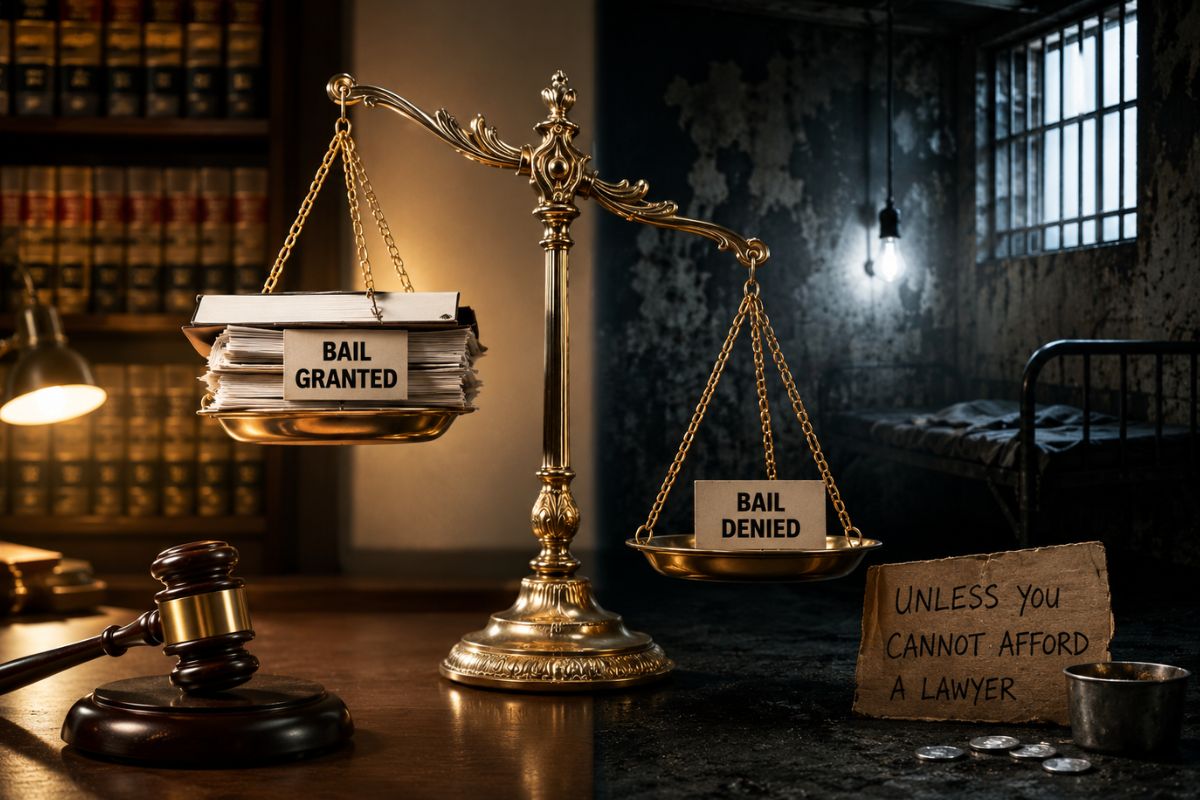
Right now, India effectively operates two bail systems under a single name. One moves quickly, argues procedural nuance with skilled counsel, and treats “bail is the rule” as an active, enforceable guarantee. The other leaves three in four of the country’s prisoners waiting, some for years, for a system stretched thin by judicial vacancies, underfunded legal aid, and a backlog that has made “exception” the practical rule for anyone without the money or the name recognition to force otherwise.
What Closing the Gap Would Actually Require
None of the fixes here are mysterious, and most have already been recommended by the Supreme Court itself, repeatedly, without adequate follow through. Filling the thousands of vacant judicial posts across High Courts and lower courts would, on its own, meaningfully reduce the backlog currently forcing pre trial detention to function as a default punishment. Properly funding legal aid, not as a symbolic constitutional guarantee but as a functioning service with the staffing to review every eligible undertrial’s case promptly, would close much of the gap between the 56 percent represented by private lawyers and everyone else. And a more consistent, less case by case application of the Under Trial Review Committee process, mandated nationally rather than left to vary sharply by state, would ensure that eligibility for release depends on time served and case merit, not on whether a prisoner’s family happened to find a competent advocate.
None of this makes for the kind of viral moment that produced a nicknamed cliff or a film deal elsewhere in this year’s news cycle. It is slower, less visual, and far less entertaining than a honeymoon murder mystery. It is also the difference between “bail is the rule” being a genuine constitutional protection and being, for most of the country, a rule that exists mainly on paper, available in practice to whoever can afford to ask a court to actually follow it.
If you or someone you know needs legal aid assistance in India, the National Legal Services Authority (NALSA) provides free legal services and can be reached through your state’s District Legal Services Authority. For concerns about undertrial detention or prison conditions, complaints can also be raised with the National Human Rights Commission.