Erasing the Lotus: When “Shared Heritage” Becomes Deliberate Hindu Erasure in Bangladesh and Pakistan
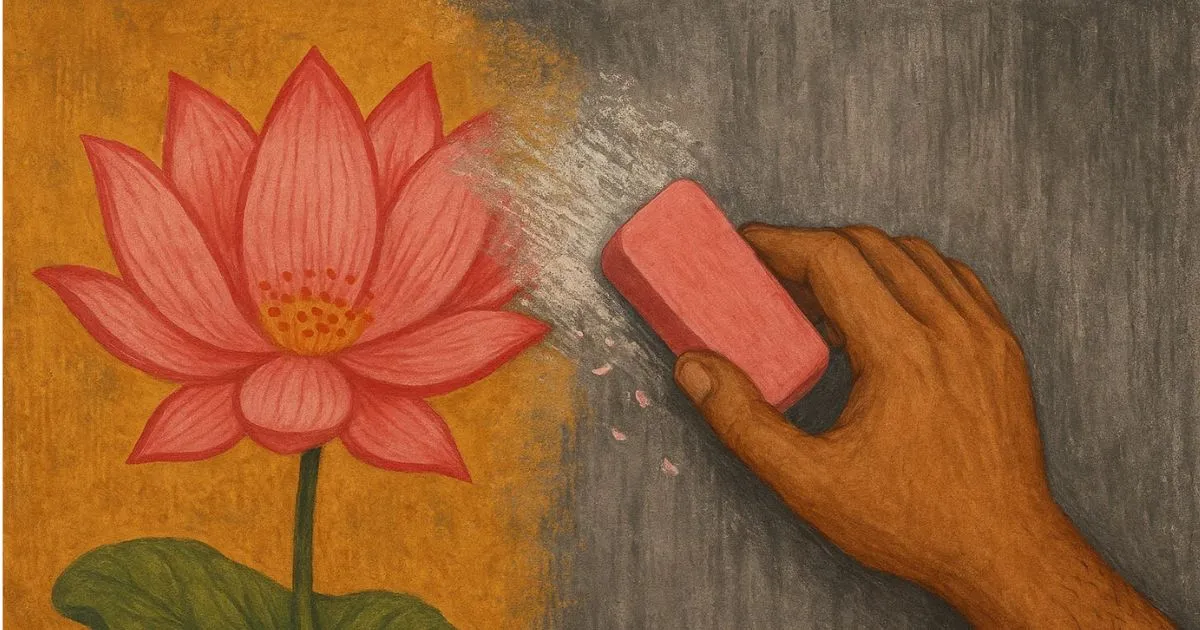
In the last few years, a disturbing pattern has emerged from parts of Bangladesh and, to a lesser extent, Pakistan: the systematic rebranding of explicitly Hindu symbols, attire, and iconography as “Mughal,” “Islamic,” or “purely Bengali/Pakistani Muslim” heritage. What begins as cultural retention by Muslim-majority societies whose ancestors were once Hindu morphs into active denial of origins often with blatant, viral falsehoods that would be laughable if they weren’t so insidious.
This is not about a Bangladeshi woman simply wearing a saree because her mother did. This is about standing on a giant white lotus, draped in a white saree with silver zari, wearing a kamarband and maang tikka, and captioning the photograph: “Mughal-inspired elegance… the purity of the lotus in Islamic minimalism.”
Let that sink in.
The Viral White Lotus Incident (2024–2025)
In late 2024 and early 2025, a Bangladeshi actress-cum-influencer (name withheld here because the point is the pattern, not the individual) posted a carefully staged photoshoot that went viral for all the wrong reasons. The visuals were unmistakable:
- Pure white saree with heavy silver work
- Pose standing inside an oversized blooming white lotus
- Minimal makeup, serene expression, hands in a namaste-like gesture
- Traditional Hindu bridal jewellery: kamarband (waist belt), maang tikka, jhumkas, haath phool
Any Hindu who has ever seen a calendar print of Maa Lakshmi knows this image instantly. Lakshmi is almost invariably depicted standing or seated on a blooming lotus, dressed in red or white, radiating serenity and prosperity. The lotus (padma/kamal) is Her throne and symbol. Vishnu’s feet are charan kamal (lotus feet). The Bhagavad Gita, Ramcharitmanas, and countless puranas use the lotus as the ultimate metaphor for purity rising from mud—central to Hindu dharma since the Vedic period.Yet the caption and subsequent interviews framed the entire aesthetic as “Mughal-era Islamic minimalism” and “Bengali Muslim elegance evolved from Persian courts.”This is not a mistake. This is deliberate historical inversion.
Mughal miniature paintings show empresses in anarkalis, peswaz, farshi pajamas—never draped sarees with kamarbands. The lotus is conspicuously absent as a primary symbol in Islamic or Mughal iconography south of Central Asia (where it occasionally appears borrowed from Buddhist art). Claiming a white-saree-on-lotus pose as “Islamic” is as absurd as claiming the Taj Mahal’s dome is a Hindu shikharam turned upside down.
The Broader Pattern
This incident is just the most photogenic example of a wider trend:
- Saree rebranded as “Mughal attire”
Fashion influencers and even some Bangladeshi textbooks now describe the saree as evolving under Mughal patronage. Reality: the draped, unstitched saree predates the Mughals by at least 2,500 years (Indus Valley terracotta figurines, Vedic texts, Gupta sculptures). - Jamdani and Tangail sarees stripped of Hindu motifs
Bangladesh has successfully inscribed Jamdani weaving in UNESCO as its intangible heritage (fair enough—master weavers live there now). But official descriptions and marketing routinely omit that classic Jamdani motifs—buta, kalka, lotus, swastika, temple borders, conch shells—are Hindu derived. Tourists are told these are “Persian paisleys” or “Islamic geometric purity.” - Bridal jewellery erasure
Kamarband, borla/maang tikka, nath (nose ring), and paizeb (anklets) are routinely called “Mughal jewellery” in Pakistani and Bangladeshi bridal shoots. These predate the arrival of Islam in India by centuries and are depicted on temple sculptures and in Natya Shastra descriptions of shringara. - Sindoor, bindi, and shankh (conch) as “Bengali culture”
Married Muslim women in Bangladesh wearing teep (bindi) and shankha (conch bangles) is common and historically explainable—ancestral retention. Calling it “purely Bengali Muslim tradition” while ignoring its explicit Hindu marital symbolism (sindoor for saubhagya, shankha for Vedic rituals) crosses into erasure.
Why This Matters More Than “Shared Heritage” Arguments
When a community retains a practice because “that’s what my family always did,” it is understandable cultural continuity—most South Asian Muslims have Hindu ancestry, genetically and culturally.But when state organs, influencers, and textbooks begin actively rewriting that this continuity is actually “Mughal invention” or “Islamic refinement,” it becomes a political project of de-Hinduisation. It mirrors what happened in Pakistan under Zia-ul-Haq: saree banned on television, sindoor discouraged, shalwar kameez declared the “true Islamic dress,” even though it too has Central Asian (not purely Arabian) roots.
The goal appears to be creating a narrative that Muslim-majority nations on the subcontinent developed an “authentic” Islamic high culture independent of—or superior to—the Hindu substrate they emerged from. This is the same impulse that leads some quarters to claim the Taj Mahal was originally Tejo Mahalaya (a fringe Hindu claim) or, conversely, that all subcontinental achievements are “Muslim contributions” while downplaying pre-Islamic civilisation.
The Double Standard
Imagine an Indian designer doing a photoshoot in a black abaya and hijab, standing under a crescent moon, captioning it “ancient Vedic minimalism.” The outrage would be instantaneous and global. Yet when the reversal happens—Hindu symbols rebranded Islamic—Western academics and liberal commentators rush in with “it’s just shared heritage” or “cultural evolution.”There is a difference between sharing and stealing credit.
Conclusion: A Call for Honesty
No one reasonable demands that Bangladeshi or Pakistani women stop wearing sarees or shankha bangles. Those are lived traditions.
What is being demanded, what decency requires is basic honesty:
- Acknowledge that the saree, the lotus, the kamarband, sindoor, and shringara aesthetics originated in the Hindu civilisation of the subcontinent long before Islam arrived.
- Stop the active, state-supported, influencer-driven project of rewriting them as “Mughal” or “Islamic inventions.”
- Let communities wear what they want, but don’t gaslight the world (and your own children) about where it came from.
Until that honesty arrives, every white saree on a white lotus captioned “Mughal elegance” is not fashion.It is erasure.
And Hindus have every right to call it out loudly.