
Sarnath Inscribed as India’s 45th UNESCO World Heritage Site
📌 Summary
Sarnath, the historic Buddhist pilgrimage site in Uttar Pradesh, has officially been inscribed on the UNESCO World Heritage List, marking the successful culmination of a 28-year wait on UNESCO’s tentative list. The announcement was made during the 48th session of the World Heritage Committee in Busan, South Korea, making Sarnath India’s 45th UNESCO World Heritage property and the fourth in Uttar Pradesh.
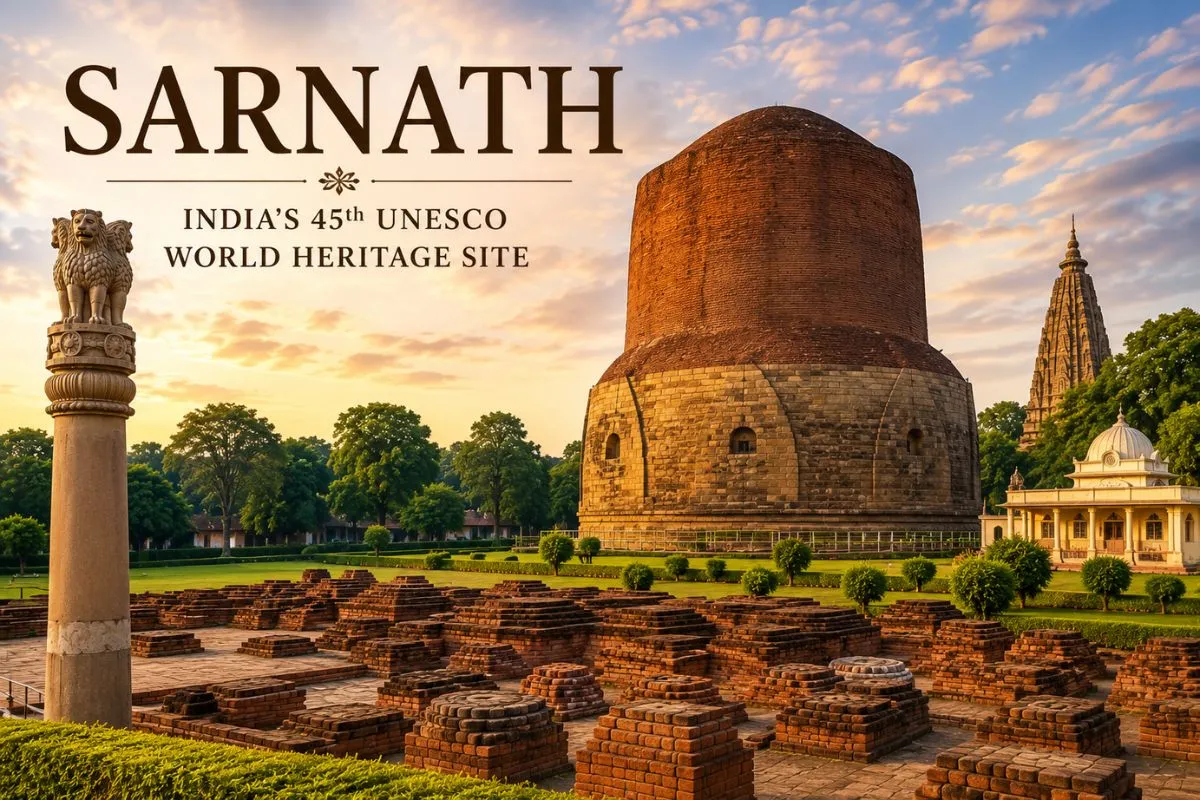
Revered as the place where Lord Buddha delivered his first sermon, the Dhammacakkappavattana Sutta, the inscription includes iconic monuments such as the Dhamekh Stupa, Chaukhandi Stupa, and the Ashokan Pillar. The recognition has been widely celebrated across social media and is expected to significantly strengthen India’s Buddhist tourism circuit while enhancing Sarnath’s global cultural and spiritual prominence.
In a landmark moment for global heritage, the ancient city of Sarnath located just ten kilometers northeast of Varanasi in Uttar Pradesh has officially joined the ranks of UNESCO World Heritage Sites. The decision was finalized at the 48th session of the UNESCO World Heritage Committee in Busan, South Korea.
For India, Sarnath marks the nation’s 45th World Heritage Site. For Uttar Pradesh, it serves as the fourth, joining the Taj Mahal, Agra Fort, and Fatehpur Sikri. More than just an administrative title, this inscription concludes a 28-year wait since Sarnath was first placed on UNESCO’s tentative list in July 1998.
The announcement triggered an immediate wave of celebration across social channels, with historians, monks, citizens, and national leaders honoring a sanctuary whose influence has resonated across centuries.
The Cradle of the Sangha: Why Sarnath Matters
Sarnath holds an irreplaceable position in world history as the birthplace of the Buddhist Sangha (monastic order).
After attaining enlightenment beneath the Bodhi tree in Bodh Gaya, Siddhartha Gautama traveled to the serene deer park at Sarnath, historically known as Isipatana or Mrigadava. It was here, around the 6th century BCE, that he preached his first sermon to five former companions. This seminal event—known as Dhammacakkappavattana Sutta (“Turning the Wheel of the Law”)—articulated the fundamental tenets of Buddhism: the Four Noble Truths and the Noble Eightfold Path.
☸️ The Journey That Shaped Buddhism
🌳 Bodh Gaya
Enlightenment beneath the Bodhi Tree
Siddhartha Gautama attained enlightenment and became the Buddha.
🛕 Sarnath
Delivering the First Sermon
“Turning the Wheel of the Law” (Dhammacakkappavattana Sutta), marking the beginning of the Buddha’s teachings.
🌍 Foundation of the Sangha
The Buddha’s first disciples formed the Sangha, laying the foundation for the global Buddhist monastic tradition and the spread of Buddhism across Asia and the world.
Over the subsequent centuries, Sarnath transformed from a quiet woodland sanctuary into a premier monastic university complex, drawing pilgrims, scholars, and royal patrons from across Asia.
The Architectural Jewels Behind the Recognition
The newly inscribed property comprises two primary protected zones featuring monumental architecture constructed between the Mauryan period and the 12th century CE:
1. Dhamekh Stupa
Rising nearly 43 meters high, the massive, cylindrical Dhamekh Stupa stands as the visual anchor of Sarnath. Believed to mark the exact spot where Buddha delivered his first sermon, its lower stone facing features intricate Gupta-era geometric carvings and floral patterns.
2. Chaukhandi Stupa
Positioned as the gateway to Sarnath, this stepped quadrangular structure marks the site where the Buddha was met by his five disciples. An octagonal brick tower was added atop the mound during the Mughal era by Govardhan (son of Raja Todar Mal) to commemorate the visit of Emperor Humayun.
3. The Ashokan Pillar & the Lion Capital
It was at Sarnath that Emperor Ashoka erected one of his famous carved pillars around 250 BCE. The original pillar’s polished base remains on-site, while its crowning piece—the four-headed Lion Capital of Ashoka—is preserved in the adjacent Sarnath Archaeological Museum. This iconic sculpture was adopted as the official National Emblem of India in 1950.
| Monument | Historical Era | Key Significance |
| Dhamekh Stupa | Mauryan to Gupta Period | Marks the site of the First Sermon (Dhammacakkappavattana). |
| Chaukhandi Stupa | Gupta Period (Mughal additions) | Commemorates Buddha meeting his first five disciples. |
| Ashokan Pillar | Mauryan Period (c. 250 BCE) | Site of the original Lion Capital, India’s National Emblem. |
| Mulagandhakuti Vihara | Ancient to Modern Era | Remains of the main shrine where Buddha stayed during rainy seasons. |
A Global Boost for the Buddhist Circuit
With UNESCO status secured, Sarnath completes a vital trifecta of World Heritage-recognized Buddhist pilgrimage hubs, alongside Lumbini (Nepal, birthplace of Buddha) and Bodh Gaya (India, site of enlightenment).
The global status is set to supercharge Uttar Pradesh’s Buddhist Circuit—a major spiritual corridor linking Sarnath, Kushinagar, Shravasti, Sankissa, and Kaushambi. International arrivals from Southeast and East Asian nations—including Thailand, Vietnam, Japan, Sri Lanka, South Korea, and Bhutan—are expected to grow significantly over the coming years.
Beyond tourism revenue, the UNESCO badge imposes strict conservation obligations under the Archaeological Survey of India (ASI). This ensures protected buffer zones around the monuments, sustainable urban planning, and enhanced preservation techniques to safeguard the ancient brickwork and stone against modern environmental stressors.
Timeless Relevance
In a world often fragmented by conflict, Sarnath’s UNESCO status brings renewed global attention to the fundamental message delivered in the Deer Park over two millennia ago: peace, non-violence, mindfulness, and the pursuit of truth. Sarnath’s inscription preserves not merely a set of ancient ruins, but the living memory of a philosophy that reshaped human history.