The Fast Track Courts Were the Promise After Nirbhaya. Thirteen Years Later, the Line Has Only Gotten Longer.
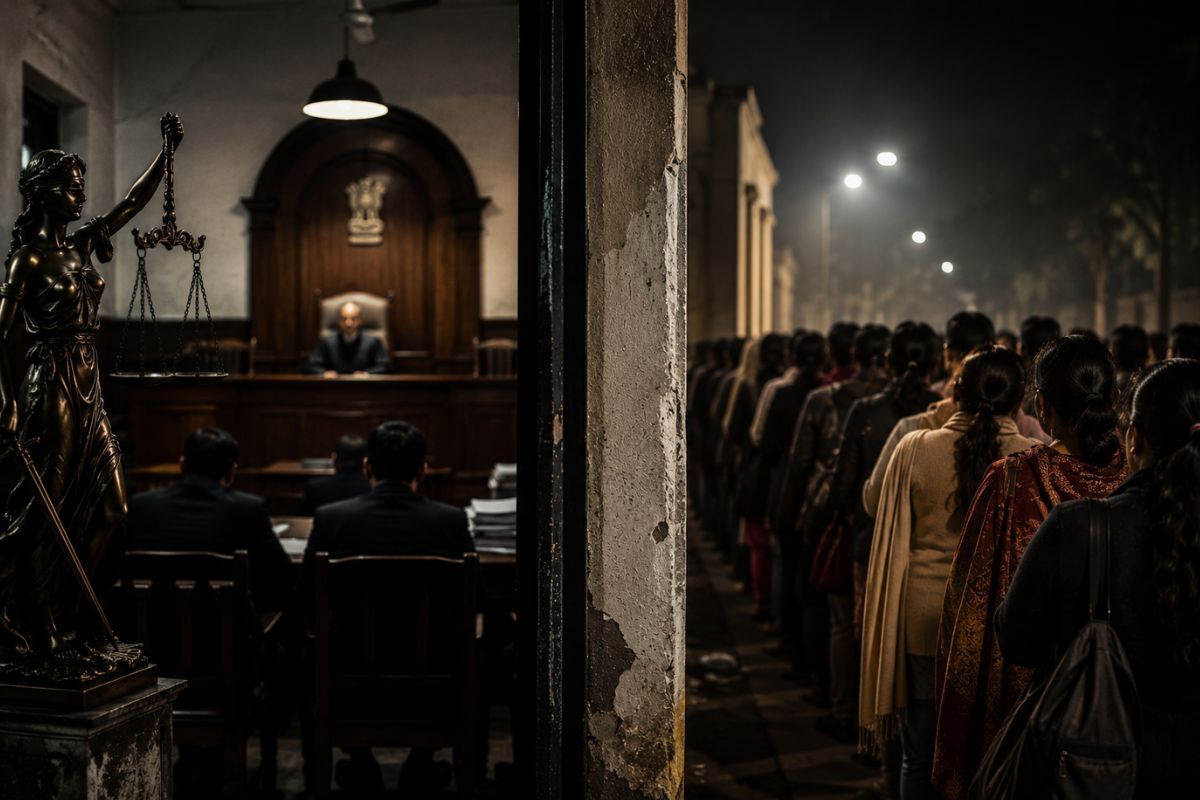
In 2019, seven years after her daughter’s gang rape and murder shook the country into the streets, the Indian government finally delivered on a promise it had made in the immediate, furious aftermath of that case: dedicated Fast Track Special Courts, built specifically to move rape and child sexual abuse cases through the system in a fraction of the time an ordinary trial takes. It was meant to be the answer to a question the entire country had been asking since December 2012: why does justice in this country take so long that survivors and their families grow old waiting for it.
Asha Devi, Nirbhaya’s mother, has spent over a decade answering that question in public, one interview at a time. Speaking about the state of the justice system years after her own daughter’s case finally concluded, she put it simply: “in terms of crime against women that we see on a daily basis, there is not an iota of change.” This piece is about why a scheme built specifically to prove her wrong has, by its own government’s data, mostly proven her right.
What the Fast Track Courts Were Supposed to Do
The scheme was formalized in August 2019, following a Supreme Court order in a suo motu writ petition demanding speedier disposal of rape and POCSO Act cases. The government committed to setting up 790 Fast Track Special Courts, including dedicated exclusive POCSO courts, funded partly through the Nirbhaya Fund itself, the corpus specifically created in 2013 to finance exactly this kind of reform. Each court was meant to be staffed with one dedicated judicial officer and seven support staff, working exclusively on rape and POCSO cases, with a target of disposing at least 165 cases a year. Section 35 of the POCSO Act itself mandates that trials be completed within one year of the charge sheet being filed, “as far as possible.”
What Actually Happened
As of the most recent data available, 758 Fast Track Special Courts are operational across 30 states and union territories, including 404 to 414 exclusive POCSO courts, and they have collectively disposed of over three lakh cases since the scheme began. That sounds, on its face, like a functioning reform. It is also, on its own, a misleading number, because it hides what is happening to the cases still waiting.
More than two lakh rape and POCSO cases remain pending in these specialized courts right now, and the pace at which new cases arrive has kept pace with, or outstripped, the rate at which old ones are resolved. Out of 2,68,038 POCSO cases that went to trial, only 8,909 ended in conviction, a conviction rate of roughly 3.3 percent. The one year disposal target written into the law itself has quietly become fiction: cases in these courts now take an average of 509 days to resolve, more than sixteen months, not the twelve the law envisioned. In states like Bihar, Uttar Pradesh, Arunachal Pradesh, West Bengal, and Meghalaya, researchers project it will take somewhere between 21 and 30 years, not months, to clear the backlogs currently sitting in these courts, at the rate they are being cleared today.
Read that again. A court system built specifically, urgently, in response to a case that shook a nation, is now projected to need three decades in some states to finish the cases already filed, assuming no new ones arrive in the meantime, which they will, every single day.
Where the Money Actually Went
Part of the answer sits in the budget. The scheme’s financial outlay for its most recent three year extension, running through March 2026, comes to roughly 1,952 crore rupees, translating to about 75 lakh rupees per court per year. Researchers examining the scheme have noted plainly that this sum barely covers a court’s basic operational costs as laid out in its own guidelines, let alone the infrastructure upgrades, forensic capacity, or victim support services these cases actually require. Meanwhile, roughly 1,700 crore rupees sitting inside the Nirbhaya Fund itself remains unspent, according to recent reporting, money explicitly earmarked for women’s safety and justice infrastructure that has simply not been deployed.
Asha Devi flagged this exact problem years ago, when she said the fund’s money was being redirected toward general infrastructure rather than the survivors and systems it was meant to serve. As she put it at the time, “it does not matter that the fund was called Nirbhaya Fund” if the government fails to use it for what it was created to do. The money exists. Spending it on the right things, consistently, has been the harder part.
Why Fast Does Not Mean Trained
Money is only part of the story. Many of the judicial officers assigned to these fast track courts are not, in practice, dedicated exclusively to rape and POCSO cases the way the scheme’s own guidelines require. Existing district and sessions court judges are frequently given “additional charge” of a fast track court on top of their regular docket, according to Priyamvadha Shivaji, a research fellow at the Vidhi Centre for Legal Policy who has studied the scheme closely. She has also pointed to a deeper problem beneath the paperwork: many of the professionals actually handling these cases, judges included, have never received specialized training in how to work with child survivors, which directly undermines the very outcomes the courts were built to improve. As she explained it, without that training, questioning a child witness takes longer and produces weaker evidence, which “does not lead to an increased conviction rate either.”
This is not a minor technical gap. A POCSO case lives or dies on the quality of a child’s testimony, recorded carefully, without retraumatizing her, by someone who actually knows how to do it. A judge holding “additional charge” of a fast track court, on top of an already full regular docket, juggling a caseload never designed to be split this way, is not the specialist the scheme was designed around. He is an ordinary, overworked judge with an extra label attached to his existing job.
What This Means for the Cases We Have Already Covered
This backlog is not an abstraction. It is the actual machinery that will process, or fail to process, cases this publication has already documented. Our earlier piece on the Sri Ganganagar case, where a 13 year old girl was allegedly trafficked and raped by roughly thirty men over five days, will eventually move through exactly this system, one already carrying a backlog that some states will need decades to clear. Fourteen arrests have been made. The trial that determines what happens to each of them will now enter a system where the median POCSO case takes 509 days, not the twelve months the law demands, in a state, Rajasthan, that already carries one of the country’s higher per capita rape rates.
The same slow machinery surrounds the ongoing CBI investigation into Twisha Sharma’s death, and it is the same machinery that, as we explored in our piece on bail and privilege, moves considerably faster for the accused who can afford to make it move faster than it does for the survivors and families waiting for a verdict on the other side of the same overloaded docket.
What Change Would Actually Require
None of the fixes here are secret. Researchers and even government reviews have said the same things for years: fill fast track courts with judges assigned exclusively, not as additional charge on top of an existing docket. Fund specialized training for every judge, prosecutor, and support staff member handling child survivor testimony, not as an occasional workshop but as a mandatory qualification for the posting. Spend the unspent balance of the Nirbhaya Fund on exactly what it was created for, forensic labs, victim support infrastructure, court capacity, rather than letting it sit unused while the courts it was meant to strengthen fall further behind. And build in genuine, externally audited accountability for the one year disposal target the law already demands on paper, rather than allowing 509 days to quietly become the new, unspoken normal.
Twelve years after her daughter’s case forced this country into the streets, Asha Devi said something that deserves to sit at the center of this conversation rather than its margins: “Until severe punishment becomes certain and swift, there will be no change.” The Fast Track Special Courts were supposed to be the mechanism that made that certainty and speed real. Thirteen years, three lakh disposed cases, and a still growing backlog of over two lakh later, the honest answer is that the mechanism exists. It has simply never been funded, staffed, or held accountable enough to do what its own name promised.
If you or someone you know needs support navigating a case moving through India’s court system, the National Legal Services Authority (NALSA) provides free legal aid, and Childline India can be reached at 1098 for concerns involving a child.