THE DAY A WOMAN SAVED THE WORLD FROM A NUCLEAR WAR — AND NO ONE REMEMBERED HER NAME
The forgotten crisis of November 9, 1979
History remembers generals, presidents, and men who pressed buttons. It rarely remembers the woman who whispered,
“Sir… something isn’t right.”
This is the true story of a single technician, buried deep inside the North American Aerospace Defense Command (NORAD), who prevented what could have been the first — and last — nuclear war.
Her name was never officially released. Her voice, however, changed world history. Let’s go back to the night the world almost ended.
Table of Contents
1. The Night the Screens Went Red
It was 3:00 AM, November 9, 1979, Colorado. Cold War paranoia was at its peak. Phones slept under pillows. Missile operators slept beside launch keys.
Inside NORAD, the dark command room hummed with computers the size of wardrobes.
Then it happened.
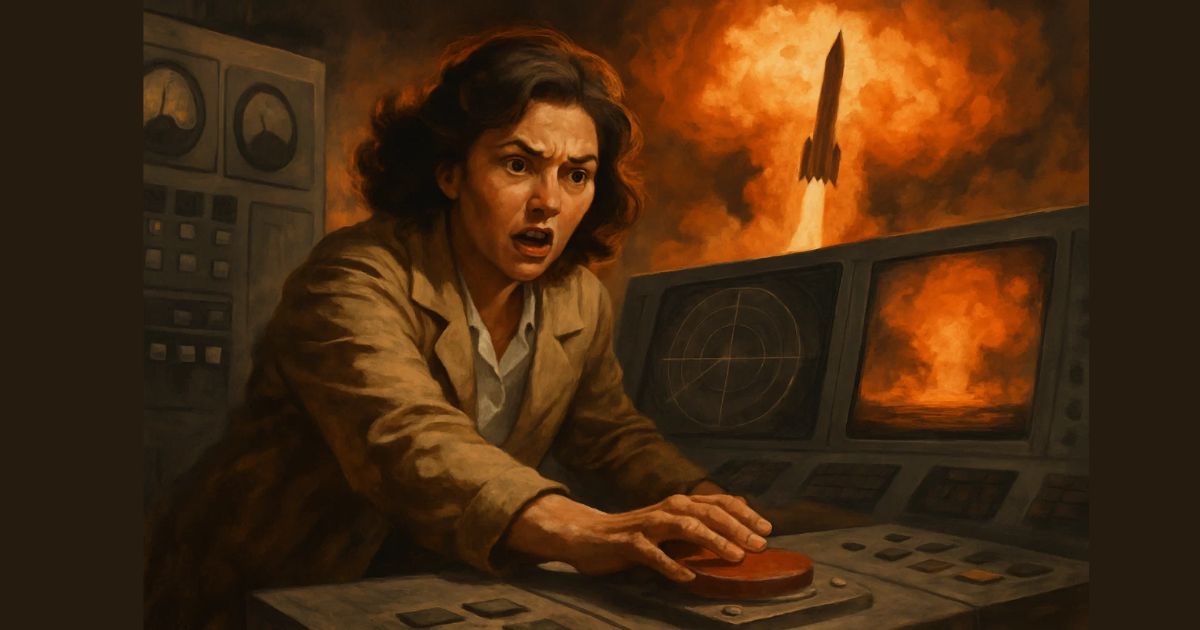
One screen turned red. Then another. Then every screen lit up with the worst message imaginable:
“SOVIET MISSILE LAUNCH DETECTED.”
“IMPACT: 7 MINUTES.”
Not one missile. Not five. But 220 ICBMs heading toward the United States.
The room froze. The shift commander ordered immediate alert. Hotlines lit up like electric veins.
In Washington, the National Security Advisor, Zbigniew Brzezinski, was woken up with the words:
“Sir, we are under attack.”
He didn’t wake his wife because if this was the end, he decided she should die in her sleep.
That is how real this moment was.
2. She Wasn’t Supposed to Speak
In the sea of panic, one person didn’t fall in line.
A young technician later confirmed to be a woman working on validation protocols stared at the data stream.
Something felt wrong.
Missiles travel in arcs. Tracks appear gradually. But the system was showing a perfect, impossible launch pattern, like a symmetrical swarm rising in sync.
Her training screamed: trust the system.
Her intuition whispered: trust your mind.
She leaned toward her superior and said the sentence that stopped the countdown:
“Sir… this looks like training data.”
Imagine saying that in a room where generals are preparing for global annihilation.
3. The Check That Saved Humanity
The superior hesitated. Checking the diagnostic meant losing precious seconds. If the attack was real, delay could cost millions of lives. But her certainty made him pause. They ran a rapid cross-check with secondary satellites. And then the truth arrived, sharp as daylight.
There were no missiles.
None.
The computer had accidentally inserted a simulation tape an old training scenario into the live system.
A glitch. A tape mix-up. A near-apocalypse caused by a machine.
Because of one technician’s insistence, the order to retaliate was never given. Because of one minute of courage, the world did not burn.
4. How Close We Came
Had she stayed silent:
- The U.S. would have raised nuclear readiness to DEFCON 1
- Strategic Air Command would have scrambled bombers
- Soviet radars, detecting sudden U.S. air activity, may have assumed an attack
- And a retaliatory cycle would have begun
- Ending in the largest grave the planet has ever known
This is not a hypothetical scenario. Declassified documents show the response chain was halfway activated. The dominoes were already falling. One voice stopped them.
5. Why Her Name Was Never Public
Government policy. Cold War secrecy. Institutional erasure.
Take your pick.
History has a habit of forgetting the quiet people who keep the world intact.
Especially women in technical or military roles during the 1970s — invisible by design.
But every declassified investigation confirms one thing:
The false alarm was caught, challenged, and halted by a single technician.
A woman whose anonymity is the cruelest irony. You can save the world and still die unknown.
6. The Human Part of the Story
Here’s the detail that haunts historians: After the crisis cooled, the technician reportedly went outside, sat on the curb, and cried.
Not out of fear. Out of the realization that she had been the last human guardrail between peace and irreversible catastrophe.
There are heroes with medals. Then there are heroes who hold the world together for one trembling minute.
7. The Hard, Uncomfortable Truth
We live on a planet where the difference between “civilization” and “ashes” is often:
- One glitch
- One tired operator
- One wrong input
- Or one overlooked woman daring to question the system
Power is not as glamorous as movies show. Sometimes it’s a fluorescent-lit room, a buzzing console, and a woman who refuses to let the world die on her watch.
8. The Dramatic Ending We Deserve
When the investigation concluded, NORAD replaced equipment, rewrote procedures, and hardened checks. But no report, no official line, no commander ever publicly credited the technician.
History got the date. It kept the drama. But it lost the heroine.
So here she is — restored, remembered, honored.
A woman with no name. Who saved every name on Earth.