
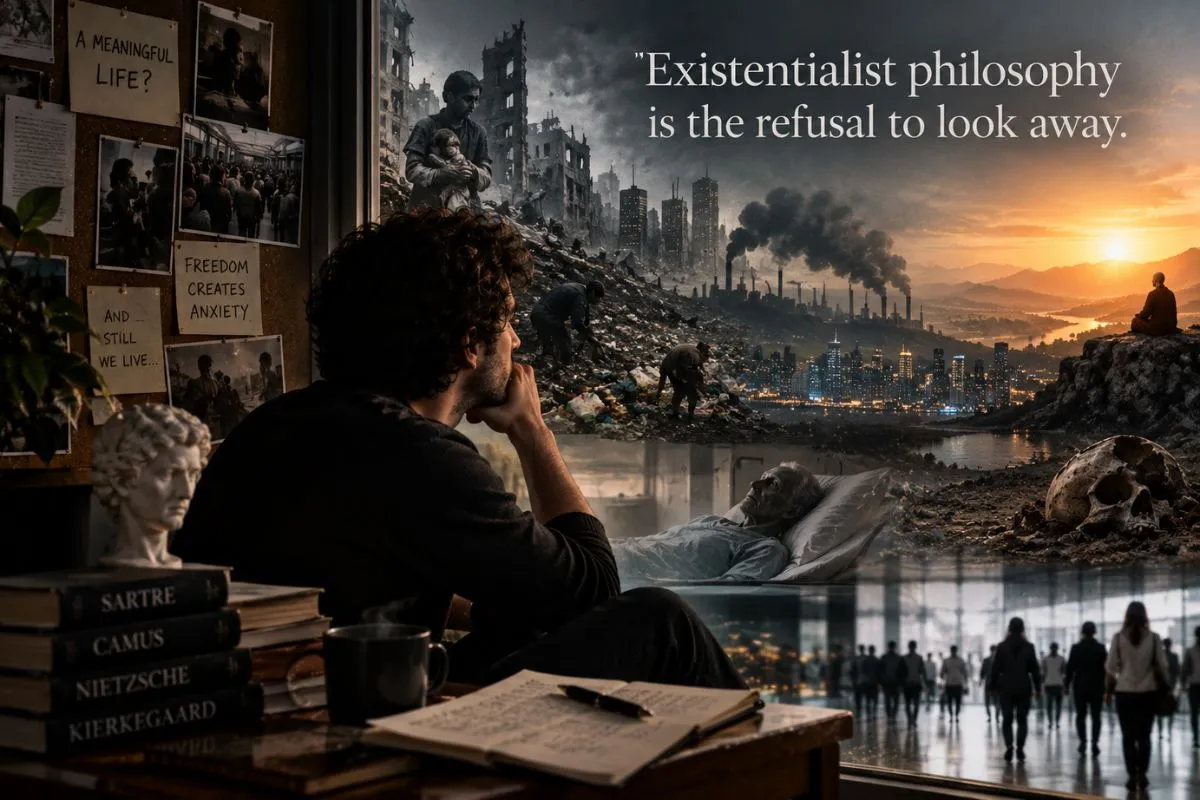
Existentialist philosophy is the refusal to look away.
It starts from the raw fact that you exist first—thrown into a world without a pre-written script—and only afterward scramble to invent what you are. No cosmic job description. No essence handed down. Existence precedes essence. That single move flips most of Western philosophy on its head.
The Core Diagnosis
You are free. Not in the soft, motivational-poster sense. Radically free. Condemned to freedom, as Sartre put it. Every choice is yours, and the weight of that choice cannot be offloaded onto God, nature, society, genetics, or “the way things are.” When you pretend otherwise, you live inbad faith—the everyday self-deception that lets you treat yourself like an object instead of a subject.
This freedom is not liberating in a gentle way. It producesangst(or anxiety, dread): the dizziness that comes when you realize the ground under your decisions is nothing but more decisions. Kierkegaard called it the dizziness of freedom. Heidegger described the uncanny feeling of being thrown into a world that was already underway and will continue after you vanish. Camus named the clash between our hunger for meaning and the universe’s total silencethe absurd.
Key Voices, No Soft Edges
- Søren Kierkegaard: The first major figure. Christianity without the comforting institutional lies. Faith is a leap into the absurd, not a rational conclusion. The individual stands alone before the infinite. Most people live in the aesthetic stage (chasing pleasure and distraction) or the ethical stage (following rules). The religious stage requires a terrifying personal commitment that no system can guarantee.
- Friedrich Nietzsche: God is dead, and we killed Him. The old values have collapsed. What remains is the will to power and the task of creating new values without nostalgia. The Übermensch is not a superhero; it is the rare human who can affirm life—including its suffering—without needing metaphysical consolation. Eternal recurrence is the ultimate test: would you live this exact life, with every pain and mediocrity, over and over forever? Most people fail the test by resenting existence itself.
- Jean-Paul Sartre: Existence precedes essence. You are nothing until you act, and even then you are only the sum of your actions. Hell is other people because their gaze turns you into an object. Authenticity means owning the full weight of your projects without excuses. Bad faith is the default setting of ordinary life.
- Albert Camus: The absurd is not a philosophy to overcome; it is a condition to confront. Sisyphus pushing the boulder is the image of the human condition. The only serious philosophical problem is suicide. Camus rejects both religious leaps and nihilistic collapse. The response is revolt, freedom, and passion—living lucidly without appeal to higher meaning. “One must imagine Sisyphus happy.”
- Simone de Beauvoir: Freedom is never isolated. We are free only in situations, and those situations include other free beings. Oppression is the attempt to turn another freedom into a thing. Ethics becomes the project of willing the freedom of others alongside your own. Gender is one of the most pervasive forms of bad faith imposed by society.
- Martin Heidegger: Less moralizing, more ontological. We are Dasein—beings for whom Being is a question. Everyday existence is inauthentic falling into “the they” (das Man), where we do what one does. Authentic existence involves resoluteness toward our ownmost possibility: death. Being-toward-death strips away the chatter and reveals the finite, thrown character of life.
What Existentialism Actually Demands
It does not offer comfort. It offers clarity and responsibility. Meaning is not found; it is made, and the making is never finished. You cannot outsource the decision of what matters. Systems, ideologies, and roles that claim to relieve you of that burden are usually forms of self-evasion.
It is anti-systematic by temperament. Kierkegaard attacked Hegel’s totalizing reason. Nietzsche mocked moral systems. Sartre and Camus rejected both religious and Marxist guarantees of progress. The individual remains the primary site of truth, even when that individual is socially embedded.
The Hard Limits
Existentialism can become a performance of intensity that ignores material conditions, biology, and collective power. It can romanticize anguish. Later critics (structuralists, post-structuralists, feminists, Marxists) pointed out that the “free individual” is already shaped by language, class, race, and history in ways the classic existentialists underplayed. Freedom is real, but it is never absolute or unconditioned.
Still, the central insight remains difficult to dismiss: the universe supplies no ready-made purpose. You wake up already responsible for what you do with the time. Most responses to that fact are forms of distraction or denial. Existentialism is the philosophy that keeps pointing at the distraction and asking whether you can live without it.
That is the exploration. No final answer, because the philosophy itself insists there isn’t one waiting to be discovered. Only the ongoing demand to decide, act, and own the decision.