The Living Anachronism: Inside the Ancient Democracy of Malana
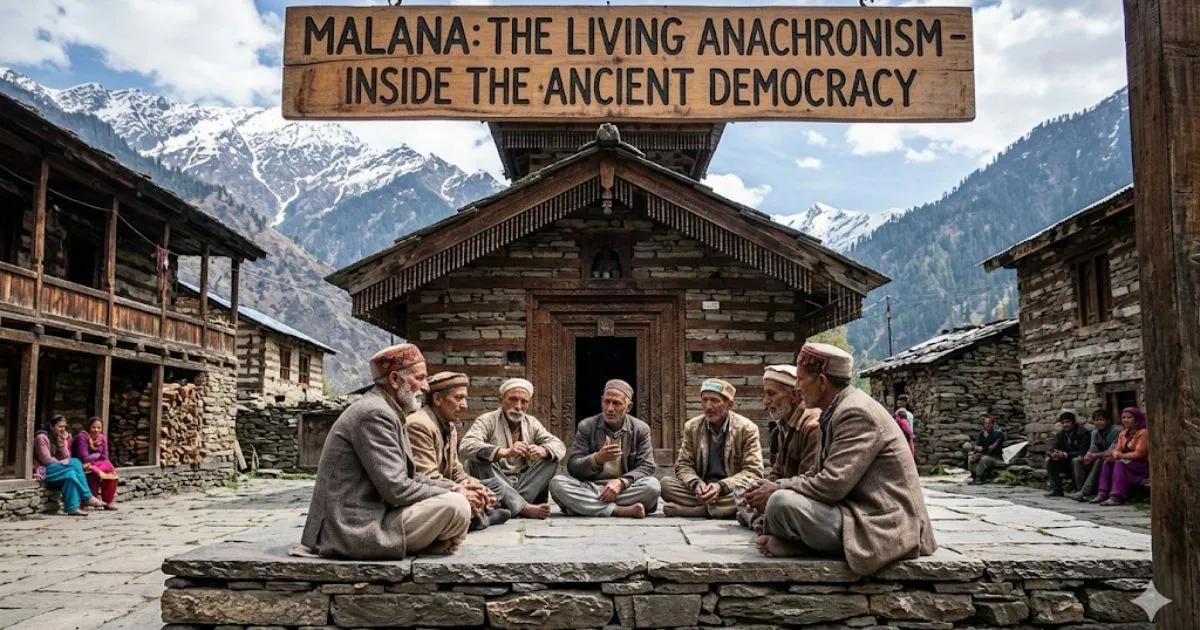
In the rugged folds of the Parvati Valley lies Malana, a village that famously claims to be one of the oldest standing democracies in the world. For centuries, Malana has functioned as an autonomous city-state, governed not by the Indian Constitution (though it is geographically part of India), but by the rigid and ancient edicts of their deity, Jamlu Rishi.
Table of Contents
The Bicameral Parliament of the Mountains
Long before modern republics established “Upper” and “Lower” houses, Malana had perfected a dual-council system that manages everything from land disputes to criminal justice.
| Body | Traditional Name | Composition | Role |
| Upper House | Jayeshthang | Three hereditary members + eight elected elders. | The decision-makers. They deliberate on all major village issues. |
| Lower House | Kanishthang | One representative from every household in the village. | The deliberative body. They bring community concerns to the Upper House. |
If the two houses cannot reach a consensus on a particularly difficult case, the village resorts to a “Divine Intervention.”
The Trial by Ordeal: In rare, unresolved disputes, two lambs are brought forward, representing the two parties. A small incision is made in their legs, and poison is applied. The party whose lamb dies first is declared the loser, believed to be the judgment of Jamlu Rishi himself.
The “Touch-Me-Not” Social Code
The social fabric of Malana is defined by a strict concept of purity and pollution. To the people of Malana, outsiders are considered Mlechcha (impure), and direct physical contact is strictly forbidden to preserve the sanctity of the village.
- Fines for Touching: In 2026, signs still warn travelers: “Do not touch.” Touching a resident, their temple, or even the walls of certain houses can result in an immediate fine (often ranging from ₹2,500 to ₹3,500), which is used to fund a sacrificial purification ritual.
- The Language Barrier: Residents speak Kanashi, a language so distinct it is understood nowhere else in the world. Linguists believe it contains elements of Tibeto-Burman and Sanskrit, serving as a verbal fortress that has kept their culture impenetrable for millennia.
The Jamlu Administration
In Malana, Jamlu Rishi is more than a god; he is the ultimate administrator.
- The Pujari: The high priest who acts as the sole spokesperson for the deity.
- The Gur: The “oracle” who goes into a trance to relay Jamlu’s specific commands during festivals.
- The Karmisht: The manager of the temple’s vast treasury and assets.
Preserving Autonomy in a Connected World
Despite the influx of trekking tourism in the Parvati Valley, Malana remains fiercely protective of its heritage. While the village has adopted certain modern amenities—satellite TV and smartphones are common—the internal legal system remains absolute. If a crime is committed within the village, it is rarely reported to the Indian police; the Jayeshthang settles it, often through social boycotts or fines paid in livestock.
Visiting Malana is less about “sightseeing” and more about witnessing a living fossil of human governance—a place where the law of the land is literally the law of the gods.